Song of the Varied Thrush

The echoey call of the Varied Thrush reminds me how  fortunate I am to work surrounded by forest.  I have been slow to learn birds, maybe because I’ve always had dogs with me when I’m outdoors.  But PJ The Springer Spaniel is getting old and I have to put her inside to rest for most of the day.  So I see more birds now.   I don’t see the Varied Thrush very much; they are quite shy.  But I hear them.  One or two have been calling this morning off in the distance, a long single note.  This beautiful song inspired me to read up on them.  They winter in the lowlands and will soon be heading for the mountains to breed.  Seattle Audubon has a good description and the song at http://www.birdweb.org/birdweb/bird_details.aspx?id=355#wa_map.

The Varied Thrush, like most birds, needs lots of cover: native trees and shrubs, especially conifer trees. They are not very common in urban areas where there is not much cover.  During the winter, they depend on seeds and berries that they glean from shrubs and the forest floor.  In warmer seasons, they also eat insects and worms. 

Russell Link’s book Landscaping for Wildlife in the Pacific Northwest gives tips on “managing your property for birds”, including ensuring that you keep a variety of levels or “layers” of vegetation: groundcovers, short and tall shrubs, short and tall trees that together fulfill a variety of habitat needs for different birds even in a relatively small area.   And you know from an earlier blog post (“Leaving”) about the value of leaving leaves on the ground.  Native birds need native plants!

News Flash!

Indian Plum Blooms, Winter Slinks Away

Paradise Valley, Washington — The Indian Plums are blooming in Ravenna Park, according to a well-placed Seattle source, Zach Andre.  Indian Plums in cooler areas like Paradise Valley are also springing to life.  The annual phenomenon illuminates forests up and down the Pacific Coast from northern California to British Columbia, driving winter from the forest and lighting the way for other native upstarts.   

“The buds began to enlarge on the Winter Solstice,” observed Shirley Doolittle, proprietor of Tadpole Haven Native Plants, a Paradise Valley nursery.  “They can tell as soon as the days lengthen by even a few minutes.”

Doolittle recommends that the public take notice of the dangling, greenish-yellow blossoms as a first step in preparing for Spring.  Paying attention to this particular natural transformation in heretofore dark forests will tend to result in other observations as well, such as the emergence of the native Trillium. This observational practice causes citizens to step off sidewalks and paths, and may cause localized anarchy in parks and natural areas.  This is no reason for alarm, she says, noting that people can use this event as a way to affirm that humans are part of nature, too. 

“This can improve psychological health for sufferers of Seasonal Affective Disorder (S.A.D.),” she stated, adding that quests for connections with nature are especially important in wintertime, when most people avoid damp and chill in favor of artificially warm built environments.  “Go play outside.”

                                                                  ###

January

Birds are chirping and rummaging through the duff and leaves for insects.  The valleys are brimfull of water.  Snow geese honk overhead as they move to a new foraging site.  The nights are growing shorter.  Indian plum buds are swelling and Hazelnut catkins shake in the breeze.  Could this be spring?  A nice thought

Leaving

Plants have been flying out of the nursery, going to various restoration projects.  They will help restore life to hillsides, parks, construction sites, disturbed watersheds and neighborhood green belts.  On a smaller scale perhaps, your yard contributes to the region-wide effort to bring healing to the land.  It is a daunting task, mainly due to various forms of “development”. 

That term generally means that nature loses out.  Even if you have only lived in the area for a few years, you know what I’m talking about.  People put their mark on the landscape, whether it involves building a new deck or new shopping center, taking down trees for the sake of lumber or cleaner gutters.  And of course, there are many, many benefits to development.  But hopefully our culture is moving in the direction of a renewed form of development: developing a culture of conservation and balance.  There is very little balance right now.  Since settlers began displacing native cultures with our current culture of extraction from and dominance over nature, the natural ecosystems have been suffering.  We have a long road to travel, both in terms of reshaping our attitudes toward nature and in terms of reshaping our man-made landscapes to bring tangible healing to the land. 

Just in case this sounds like liberal – even radical – claptrap to some, I’d like to remind people that I’m advocating a conservative concept: conservation.  Conservation means using nature while protecting it.  We are humans.  We need to use nature.  But in the past 150 years, we have been engaged in a truly radical reshaping of the natural world in the Pacific Northwest that has destroyed whole populations of species.  And to our own detriment; we’ve brought physical and mental ills upon ourselves.  The book Ishmael, a somewhat woo-woo tale about a talking(?) gorilla, teaches about the difference between “Takers” and “Leavers”.  We are, overall, a society of “Takers”.

The good news is that we each have some power to change things, to help heal our bit of this planet.  You have some bit of land that you have responsibility for.  Find ways of enriching the natural life that is already there.  Work with your spouse, your neighbors, your church, your homeowners association to create large and small swathes and patches of healthy, life-filled land.

 I was loading Cedars and Ninebark into the truck for delivery to a project site and spotted a Long-toed Salamander curled in the spaces between the pots. I carefully picked it up and set it under the big quince bush (not a native, but great hiding place for birds, bunnies and other critters).  It instantly disappeared, blending in perfectly with the golds and browns of the decaying leaves. 

Yesterday under a pile of Sword Fern fronds, I found another one.  In some ways, our daunting job of restoring balance to damaged nature is simple and easy.  As Brian Bodenbach (my inspiring partner and owner of Biosphere, a landscaping company) likes to tell people, “Leave the leaves!”  How easy is that?  Leaf litter provides protection and nourishment for a host of creatures, which in turn provide food for birds, for example.  Wherever you can, take that one simple step of healing! 

Be a “Leaver”!

Wakey-wakey!

Morning. Still dark. Cozily curled in the fetal position, I reluctantly come to terms with the clock.  I think it will be another beautiful day.  The Cottonwood leaves are on the ground now.  Yesterday I crunched through them on the way to the lake, where I found raccoon footprints and a partly devoured, decaying salmon carcass.  The air is crisp and Jupiter still rises in the early evening.  Last night it hung like a pearl from the neck of  Sister Moon.  Aaah, Autumn…

That’s right—it’s Fall!  Time to wake up and think about Spring!

“WHAT? It’s not even Halloween!” you say.  “That Tadpole woman is worse that the stores that start hawking Christmas three months ahead!  Spring is FIVE months away!”

But Fall IS the ideal time to plant, because roots have a chance to get established before the summer drought.  SO no curling up in a fetal ball for you!

You have to plan now for Spring gratification.  Goatsbeard (Aruncus dioicus) must have been designed to satisfy the lazy gardener.  Right now it is yellowing and starting to die back.  In another month, nothing will remain but brittle stalks, perhaps holding a few seedheads.  Hunkered down in the earth, the pinkish crown of the plant waits for warmth.  Once it begins to grow in the spring, it shoots up rapidly.  Its bright green tower of fine, astilbe-like foliage reaches 6-7’ tall.  The name comes from its flowers – white tassels.  The male flowers are fuzzier than the female flowers, which are on separate plants.

 Goatsbeard tolerates full shade and thrives in partial sun.  It can handle pretty damp places, but doesn’t require that. In full sun, it will do fine if it has “wet feet”.  If you have both male and female plants, you will get lots of Goatsbeard “kids”.  

 Plant first, curl later!

Planets

Yesterday afternoon, the rustle – almost clatter! – of Cottonwood leaves soothed me as I worked in the nursery.  I worked until dark.  That was a worry to PJ, my Springer Spaniel.  She was close on my heels, sitting practically on my feet whenever I stopped.  She knows that night belongs to wild things and she doesn’t want to meet ANY of them!  As I walked across the field to the little cabin that houses my office, I noticed a brilliant star in the east – the planet Jupiter.  This morning I woke to fog on Planet Earth.  I can barely see across to the shoreline where the White Pines grow.

Western White Pine (Pinus monticola) is big; it CAN grow up to 150 feet tall. Evenly spaced whorls of  branches give the tree a majestic symmetry. On my property, it’s growing in the wet fen, but it is commonly found in seemingly opposite conditions, in dry gravelly spots.  A deep, wide root system binds the soil together, making it excellent for erosion control on steep slopes.

Over the last century, we have lost many of our Western White Pines to White Pine Blister Rust, a fungus which requires two different plants to host it in different phases of the disease cycle. The disease  moves back and forth between white pines and species of gooseberries and currants (Ribes species).  The plants that I currently have in the nursery are specially bred to be 90% resistant to this disease.

 Keep your eyes peeled for Jupiter and White Pines.  Enjoy your Planet.

Seeds

I’ve been reading a good book, Gardening with a Wild Heart: Restoring California’s Native Landscapes at Home by Judith Larner Lowry.

Though she works with a different set of landscapes than the landscapes of the maritime northwest, the principles work anywhere.  She strives to reconnect people with the land around them.  Environmental healing depends on that connection.  I think we can take it one step further: that our own mental and physical health depends on our connection to the land, to the earth.  Nurturing native plants in your own garden is one way to reconnect.  We can observe and participate in the natural interactions of the living soil, birds and insects with plants that have been part of their home since time immemorial.

 Lowry writes of plant propagation – planting native plant seeds – as a crucial life-giving work.  I will use her words to encourage myself as I take on the task at Tadpole Haven of sowing seeds for future crops.  My tools and techniques are very low-tech.  The job can be tedious and slow, with no guarantee of success.  Collecting seed is fun – it requires getting out into the great outdoors, often into new territory.  But it is hard for me to stand at a counter and fill flat after flat with the seeds I have gathered.  Lowry reminds me that planting seeds heals, gives life.  By planting, I take a stand in favor of life.

Air change

The air has changed.  I already feel nostalgia for summer.  Every year as summertime draws to a close, one particular summer morning, I feel the change.  The air heralds the change:  the chill in the early-morning fog, the clarity of sound, the vibrancy of greens and yellows in the sideways sunlight.

The swallows are out in force catching insects on the water’s surface.  Six perch on the bench and the rowboat as I approach so close I can see the narrowness of their necks and the shininess of the feathers on their heads and wings.  One has a silver thread arching from its beak – they have been chowing on spiders.

The spiders are more active now.  The path up to the mailbox is blockaded by a dozen webs.  I pull a bracken fern and hold it in front of my face as a web-clearing device so I am not strung with webs (and their weavers) by the time I reach the top.

I demonstrate this practical technique to my friend Debbie; her response surprises me.

“I like the way spiderwebs feel on my face.  It makes me feel caressed.”

Caressed.  The word is an invitation to change.  And allow a small thing in nature that my tidy, insular self usually resists – to bless me.

Bird Haven

June 21

robins, June 16

FEED me! June 16 June 21

June 18

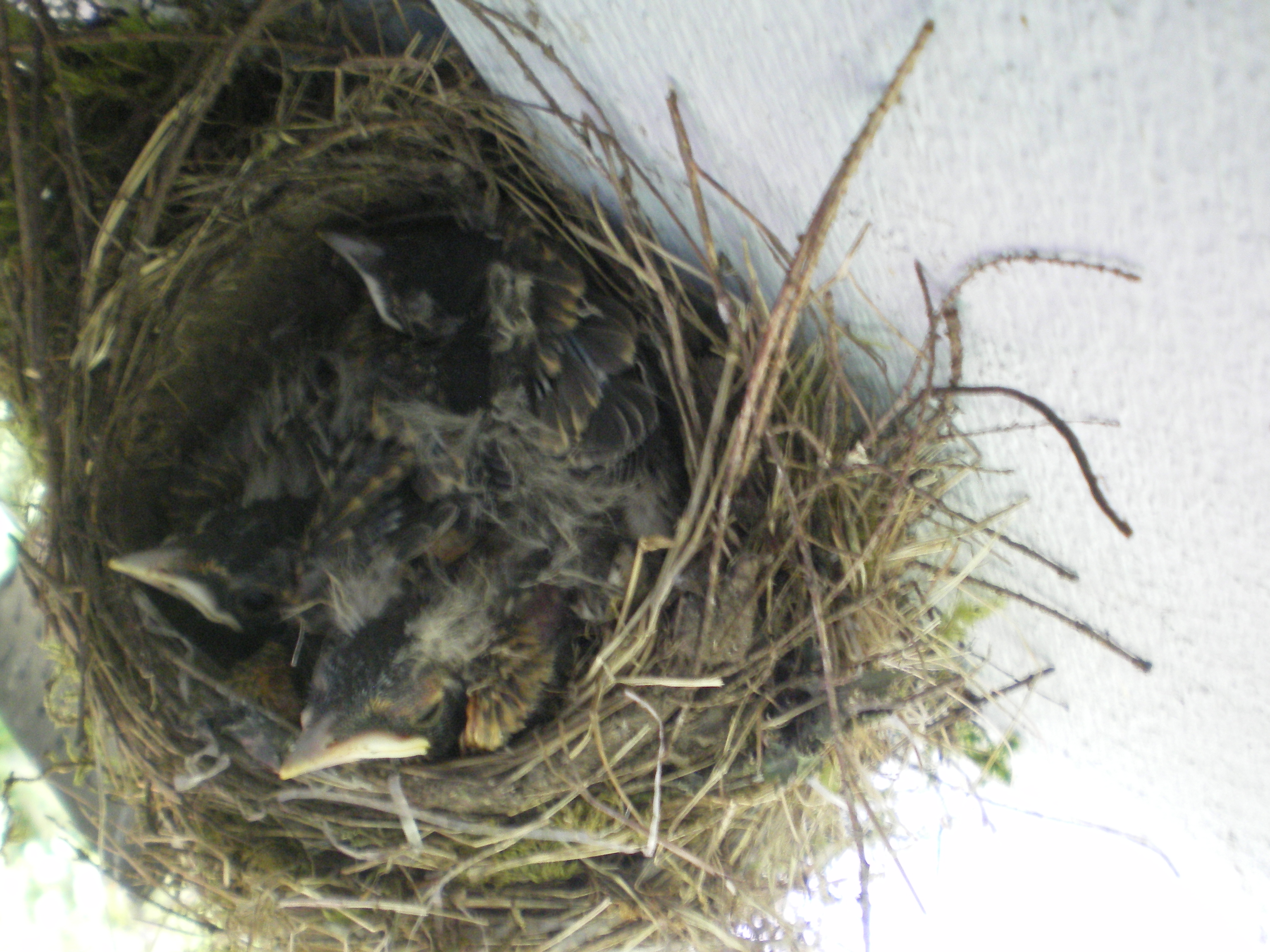
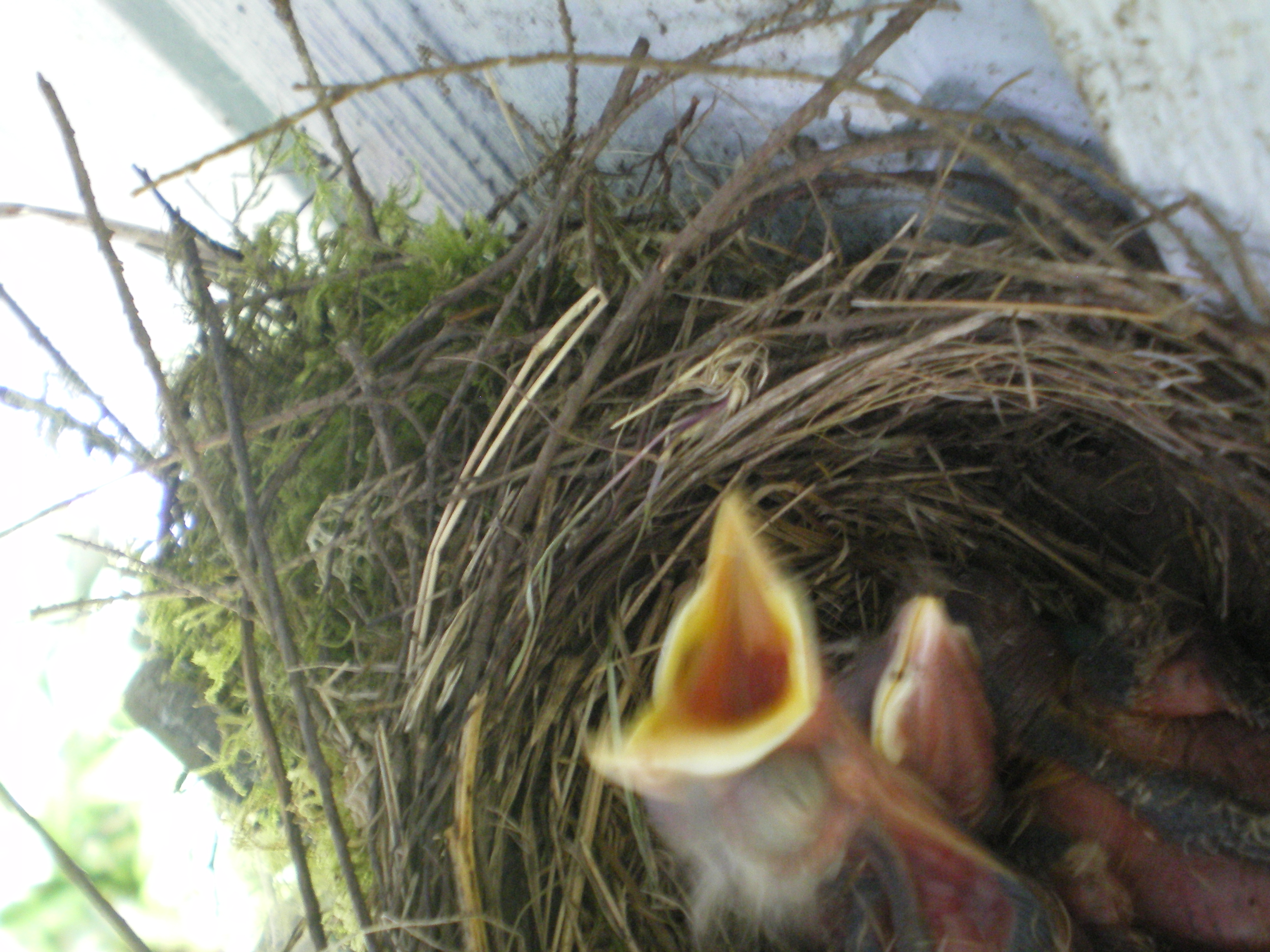
Just a quick update on birdlife in and around the nursery.  The robins that built their nest on the porch light have 3 babies  (there were 4 eggs – one didn’t develop all the way and I found it under the nest today). A hungry raven was hanging about one day, but I successfully scared it off.  There is a second robin’s nest – right in the middle of the nursery in a big elderberry bush. Haven’t seen any babies yet.

 There is also a junco who for the second year in a row, has built a nest among the stack of pots.  Last year, the nest was closer to the ground and something got all the eggs.  This time the nest is higher; so far so good!  The mama is very brave and won’t fly off her eggs until I am just a few feet away.  Then she alights close by and tries to get me to chase her. If that doesn’t work, she flies into the Bigleaf Maple sapling that shades the field growing beds.  She fusses: “Chit… chit… chit… chit!” 

 As these babies get ready to fledge, I’ll have to keep PJ, my Springer Spaniel bird dog/compost turner on a leash, I think.  She already caught two fledglings earlier this spring.  A tragedy, but I couldn’t punish her for doing what she was bred for!  She was so proud of herself.

 I’ll be working out a schedule of Open Days for July and August shortly.  Check the website, or ask to be put on my email list for updates. — Shirley

The weather is about to break

The weather is about to break.  It has to, or we’ll all go insane!  Hopefully we’ll have a sunny day on Saturday (June 12) for Picnic Day.

A lot has been happening at Tadpole Haven.  Many more plants are ready than just a month ago:  Smith’s Fairybells, Orange Trumpet Honeysuckle, Waterleaf, Serviceberry and more. We’ve got a new Bat House – it just needs some summer residents. The Robins are on their second brood – the first didn’t make it, nesting on top of the cabin’s porch light. Our plants are growing very lush (check out the Wood Ferns, Lady Ferns and Inside-out Flower).  The pollinators are busy (bees et al on the Waterleaf, flies and beetles on the Goatsbeard – anybody know the species?).  The Chorus Frog tadpoles hatched a while back and like to hang out around the sides of their kiddy pool.  And we’re trying something new to help shade the nursery this summer: vegetables!  Why not?  We’re watering anyway.  Though it’s hard to imagine right now, some parts of the nursery get blazing hot in the summer, which really stresses many plants.  We’re planting beans, peas and corn in strategic places so they will provide shade – I hope they are tall enough by July to do some good.

It’s been pretty good weather for native plants, though I have seen a little more fungus activity than normal — spotty leaves, for example.  If a plant  in your yard – native or “exotic” – seems to regularly suffer from some kind of fungal disease, it is probably not in the proper conditions.  At Tadpole Haven, we generally don’t treat our plants for a minor fungal problem. We don’t use fungicides.  We may trim off the infected foliage to keep the fungus at bay.  And if a plant or a group of plants in the nursery is really threatened by some fungal pest, we’ll try putting them in a different location, either out of the shade so they get more heat and light, or under the trees or hoop house cover where they will be drier.  It seems to be a wise nursery practice to not put all the pots of one species together in one place – that often prevents a fungus from spreading.  Plants in containers have special needs – they are more vulnerable to any kind of disease or pest or weather extremes.  Maybe I should baby them, but I don’t.  I often call Tadpole Haven “Boot Camp for Native Plants”.  If they survive here, they should do great in your garden!  I think that’s actually true.