The Power of a Raindrop

If you need free entertainment on a winter day in Puget Sound Country, you can always watch raindrops landing.  I was doing just that a few days ago.  It was so fun.  And exciting.  Like reality TV, only smarter.  They were big heavy drops landing in a pond and I could actually see the vertical splashes and the sideways waves.  There is a lot of force behind a raindrop. 

 Water–accumulated raindrops–has to go somewhere; if it isn’t stopped, it will rush into streams and lakes and Puget Sound, carrying pollutants from our streets and lawns with it.

 Native plants disperse the energy, preventing erosion, and allowing rainwater to filter down into the soil, recharging aquifers and providing summer water for streams.  Some of the best plants for taming the power of raindrops are available at Tadpole Haven.

 Evergreen trees, shrubs and groundcovers are extremely useful in dissipating that energy.  Because they still have leaves or needles during the rainiest months, the raindrops don’t hit the ground with full force; by the time the water gets to the ground, it is calmed, slowed and more easily absorbed.  In fact, a large percentage of the rain falling on a forest dominated by evergreen conifer trees–up to 50 percent—is held in the canopy and eventually released back up into the atmosphere (oh goody more rain), never hitting the ground at all!

 Two evergreens:

  • ·         Grand Fir (Abies grandis), a tall conifer witih shiny deep green needles.
  • ·         Tall Oregon Grape (Mahonia aquifolium), a narrow-growing shrub with holly-like leaves, yellow flowers loved by hummingbirds and edible (though tart) berries.  This is a good choice for stabilizing sandy slopes; you can see it doing its work high on bluffs around Puget Sound

 Four Plants that can deal with soggy spots:

  • ·         Cascara (Rhamnus purshiana), a small tree, has berries that birds love.  If it’s growing out in the open, it has a round spreading canopy; in the forest among tall conifers, it tends to grow straight up toward the light (up to 30’ tall).
  • ·         Piggy-back Plant (Tolmiea menziesii).  You know I love piggys (see In Pursuit of the Piggy-back).  They are a fun shade loving perennial.
  • ·         Large-leaved Avens (Geum macrophyllum) loves sun, moisture, butterflies and your socks (the seeds like to glom onto anything you’re wearing that is fleecy and use you as a seed distribution vehicle.  It has cute yellow flowers and because it is good at spreading its seeds around, it is a good pioneer plant in disturbed open areas.
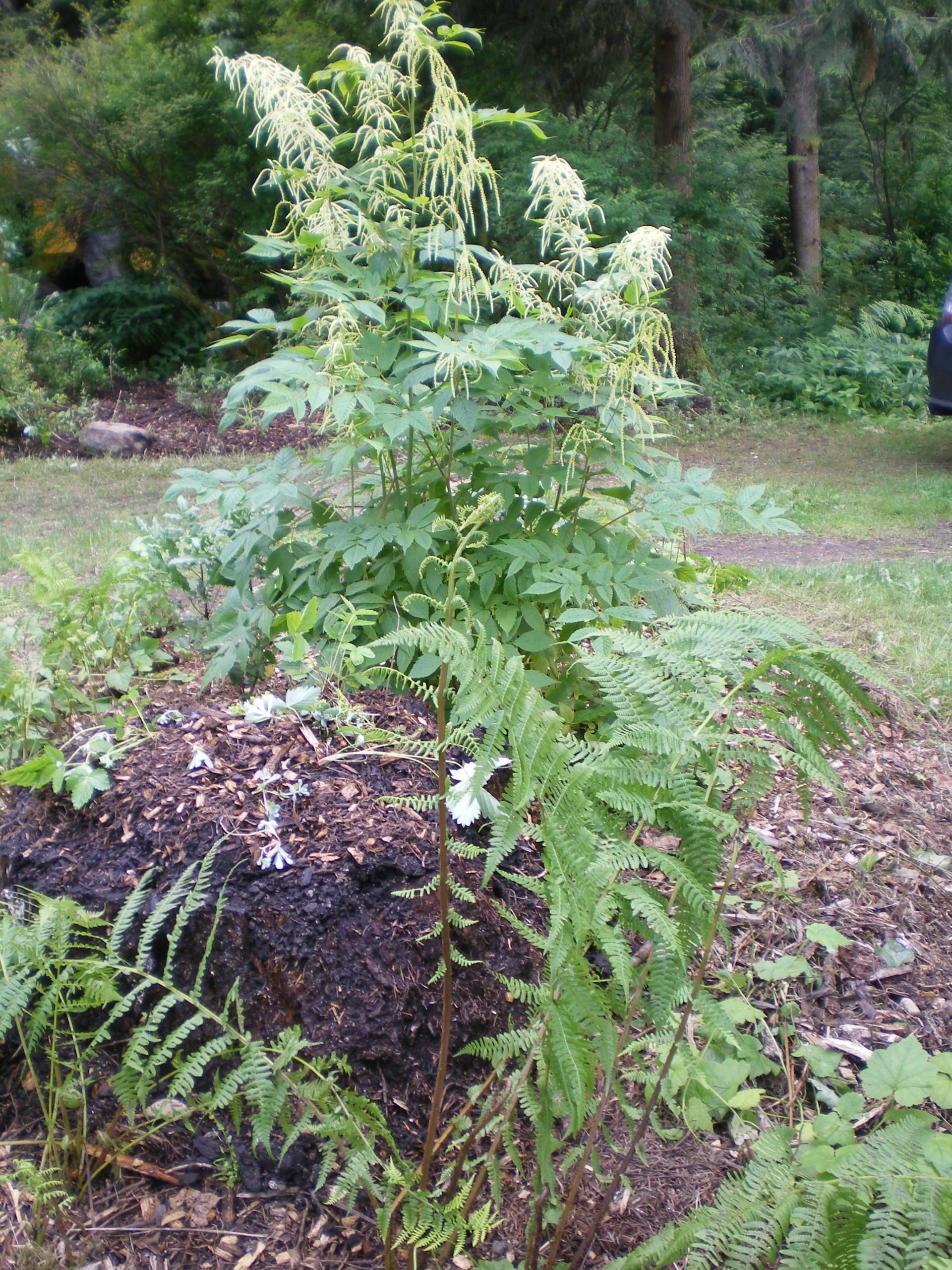
  • ·         Goatsbeard (Aruncus dioicus) likes to be beside, but not right down in, wet spots like streams, seeps and rain gardens.  It is usually found in the shade (not always near a wet spot), but if it has access to moisture most of the year (your soggy spot), can grow in very sunny places.

 Two other species to help temper the force of our winter rains:

  • ·          Thimbleberry (Rubus parviflorus) does well where it gets some shade, say, on the edge of a grove of trees.  It would be a good choice for a slope; its spreading rhizomes bind the soil together, keeping it from slumping and washing away from the power of raindrops.  Thimbleberry forms a thicket, with pretty white flowers in spring and yummy berries in the summer.
  • ·         Garry Oak (Quercus garryana) will grow up to be a mighty, spreading tree, with roots to match.  It does best in areas that drain well; it won’t thrive in soggy soil.·

Seeds in the dark time

December. The darkest part of the year. The rich and beautiful greens in the forest turn to black by late afternoon. But the proud little Grand Firs in the nursery cheer me like fine Christmas trees. The lingering leaves of the Thimbleberries glow like a congregation of candles. And someone has turned on all the moss – on the rooftops, up in the tree branches, beside the path, in the lawn — the LEB*s are all aglow. The Snowberries are the only snow in the nursery – suspended on nearly-invisible twigs, the brilliant white berries ornament the day like stationary snowflakes.

In the greenhouse, a bowl of bright red berries from the Orange Trumpet Honeysuckle awaits my attention. The berries are bursting with seeds, waiting to be spread in flats and placed under the big Western Hemlock mother tree. There they will sit until inspired by lengthening light-time that will begin after we turn the corner of the Winter Solstice. And in the dark soil, they will sprout.

May the holidays lighten your winter lives and may the New Year find you planting bright seeds for your future.
.
.
.
*Light-Emitting Bryophyte

Unrest in the Forest

“There is unrest in the forest

There is trouble with the trees

For the maples want more sunlight

And the oaks ignore their pleas.”

Brian* has been driving me a little nuts lately humming this Rush tune.  The ballad goes on, neither side giving ground, and the whole forest has a bad end.  We had an extensive ideological discussion (e.g. Did Neil Peart compose this song with Ayn Rand’s philosophy in mind?).  Kind of a tough way to wake up on a Sunday morning.   My take-away: these lyrics illustrate dysfunctional community.

Luckily, the Big-Leaf and Vine Maples get along fine with the Garry Oaks at Tadpole Haven.  Actual native plant communities change and grow relatively harmoniously, adapting to disruption and allowing for natural succession.  In the forest near the nursery, Western Hemlock, the most common large tree, shares the limelight with Sitka Spruce on the wetter north edge and Western Redcedar and Douglas Fir on the drier southern edge.  Underneath grow a wide variety of shrubs and small trees.  Even in the wettest areas, Salal and Red Huckleberry thrive up on hummocks and stumps next to Cascara and Oval-leaved Huckleberry, plants that love the wet.  This “plant” community is of course part of a larger community of life – home to amphibians, hawks, pileated woodpeckers, squirrels, bobcat and coyote.

Communities function properly only if each member helps the other members meet their needs.  A forest is a beautiful example – from the fungi that enhance the tree roots’ ability to absorb nutrients to the old hemlock snag that harbors insects that the woodpecker feeds on.

Humans are part of our forest’s community also.  It has been logged at least twice.  My cousin harvests firewood.  I gather seeds and cuttings.  My children and nieces keep a trail open for us.  The road along the southern edge and hundreds of daily commuters are also part of this forest community.  Most of the commuters are oblivious to the forest community they are part of, but they still affect it and are affected by it.

Humans are part of communities of nature.  One way humans help communities function better is by planting native plants.  Even a small-scale plant community in a backyard builds ecological health and resilience.  Native plants provide services such as filtering runoff from roofs and roads and shading and cooling rivulets and streams, which keeps oxygen levels high for fish and other aquatic animals.  They provide homes for pollinating insects valuable to agriculture.  They provide habitat for wildlife and birds.  Less tangible are the spiritual benefits; a patch of native plants in an urban area is an oasis apart from concrete and lights, for example.

Speaking of community, the election ends today.  Hopefully, all our government officials will now act like members of a forest community and work for the common good.  As for me, after a few days allotted for wound-licking and/or gloating, I will again enjoy the company of friends and relatives I’ve been avoiding during this “silly season”.  I will TRY to be a good community member, accommodating others’ needs and quirks ;).


*Brian Bodenbach,owner of Biosphere Landscape Company

Deer (Fern) Hunting Season

Hunting season is upon us.  But this morning’s fog eerily shrouded the woods and nursery and inspired me to huddle in my new safe cozy office.  Though I much preferred to stay in and – oh, I don’t know – balance the checkbook and evaluate cash flow, some primal urge overwhelmed my reluctance.  I pulled on my camo, grabbed my weapons and ventured out on a hunt for the not-so-elusive Deer Fern (Blechnum spicant).

Deer Fern proved a willing and congenial object of prey for my straight-shooting camera and ever-sharp pen and notebook.  Deer Fern’s deep green spreading fronds and its graceful vertical reproductive fronds soothe the eye, bringing out the best in those who seek it.  It naturally inhabits moist to wet shady forests.  It grows among native mosses alongside Lady Fern and Red and Oval-leaved Huckleberries in the shade cast by Cascara, Pacific Yew, Red-Twig Dogwood, Western Hemlock, Sitka Spruce and Western Redcedar.  It is part of the ground layer component of the forest community.  Not inclined to put up a fight.

Out on safari, I found Deer Ferns hunkered with Lady Ferns in a dark depression left by the rootwad of a fallen cedar, where it will be very wet and muddy once the rains hit.

Bravely traipsing onward, I spotted it in a much drier spot — on the edge of the mown field in a transition zone just upslope from a forested wetland.  Salal, Lady Fern, Sword Fern, Trailing Blackberry, Hardhack, Bracken Fern and Salmonberry shared this spot in front of a Western Redcedar.  The afternoon sun hits this spot full force.  I think the protection of the surrounding plants, along with the fact that this area stays moist all winter, enables the Deer fern to thrive.  Though adaptable, it will not do well in dry shade.

In a strategic flanking maneuver, I moved in on my prey near a seasonal stream (a couple feet above the wet).  I caught it sharing a bed of Stairstep Moss with yellowing Wild Lily-of-the-Valley, whose mottled beige berries will ripen to clear ruby-red after its leaves disintegrate.  This landscape-specimen-quality Deer Fern had plenty of elbow-room for its rich evergreen foliage – it was about 2 ½’ wide.  Its vertical fronds had faded from their summer Kelly green and were now gold and black.

I got a 10-point Deer Fern in my sights; it was co-existing with Salal in an area that occasionally experiences inundation in the winter.  Its three-foot-tall reproductive fronds (which hold the spores) were tastefully draped with finely-embroidered spiderwebs.  The moisture in the air set off the spider art.  I mercilessly took it down with my hunting weapons: slashing notes with my pen, digitally snatching trophy images to mount on my web-site wall.

All in a day’s work for a professional Deer (Fern) Hunter.

Waiting for the rain, September 20, 2012

The angle of light tells us that a new season is upon us, but this glorious weather has me in denial. That desperate, end-of-summer feeling has given way to a feeling akin to slowly eating a Dove Bar, every bite and calorie fully appreciated. Every day of sunshine feels like another bite of dessert to be savored with gratitude.

The woods are waiting for the rain. Crispy golden leaves from Black Cottonwood (Populus trichocarpa) are beginning to fall, and lie curled up in the path or skitter across the road.

The moon is waiting for the rain. The smoky gold-red crescent settled into the west as I drove home tonight, deliciously beautiful. I made a point to take a good long look before going into the house.

Fun with Squirrels

Still summer, but for the last month I’ve felt that desperate annual anxiety, knowing that I can’t possibly fit in all the warm-weather fun I fantasized about last February. Instead, I need to prepare for winter.  My to-do list is much longer than the already-done list: weatherstrip the door to the new office, finish the floor insulation (requires laying in the dirt – ugh), caulk windows, repair leaks in potting shelter cover (MAYBE it will last one more winter), move into the greenhouse plants that tend to suffer in sodden pots.  You get the picture.

I have done some canning and freezing (with lots of help from my sister Kay and niece Heather), including freezing a small cache of Red Huckleberry (Vaccinium parvifolium) and canning syrup from native Trailing Blackberriy (Rubus ursinus).  My friend Debbie says that she gets in squirrel mode in August storing up food and preparing for rainy weather (rain?  That stuff AGAIN?).  I’m trying to think like a squirrel.  It gives me something positive (even fun) to do to counter my late-summer angst.

I think squirrels have fun getting ready for winter.  Sitting outside the other morning. I periodically heard a series of clunks.  The noise came from high up in a tall Sitka Spruce (Picea sitchensis) in the forested wetland.  I watched a Douglas Squirrel zip from branch to branch, often scurrying out nearly to the tips, nipping off still-green cones.  Clunk, clunk-clunk, clunk, the cones fell through the branches to the forest floor.  The small dark-brown-and-rust-colored Douglas Squirrel, also called a Chickaree, creates stashes of conifer cones to munch on all winter.  They do well here, where we still have native forest.  They don’t adapt to urbanization, unlike the Eastern (non-native) Gray Squirrel, which thrives in suburbs and cities.

In my former office across the field, I looked out on a big Douglas Fir (Pseudotsuga menziesii) that stands apart from the other trees near the driveway.  The squirrels loved that tree and distracted me from my work, chirping at me. I’d try to answer back in squirrelese.  They are sociable and fearless.  I watched them skittering around the tree trunk.  They watched me watching the computer screen.  This time of year, they’d harvest cones from high up, bombing the humans and their cars.

Over the years, we had kept the English Ivy (Boo hissii) at the tree’s base from clambering up the trunk, and finally made a concerted effort to pull it all out to free the struggling native plants underneath.  But, until the native undergrowth recovered — Cascade Oregon Grape (Mahonia nervosa), Salal (Gaultheria shallon) and Trailing Blackberry – the squirrels did not use that lone tree.  They had lost their protective cover.  They eventually came back, but last spring, we limbed the tree up quite high to allow more light to reach the ground (for improved human habitat).  Once again, the squirrels have forsaken that tree.  Apparently, they needed the mid-level branches.  Or they’d appreciate it if we planted a smaller understory tree like a Vine Maple (Acer circinatum) or Pacific Dogwood (Cornus nuttallii) right next to the Doug Fir.  Luckily they have a whole forest just 50 feet away, but I miss seeing them.

Celebrations and the Stumps of Shame

Celebrations surround the nursery right now.  Fertility, fresh-paint, rainwater, summer’s-coming, nest-construction, salmonberry-snacking, digging, hatching, hammering, growth!  Everyone is in on it!

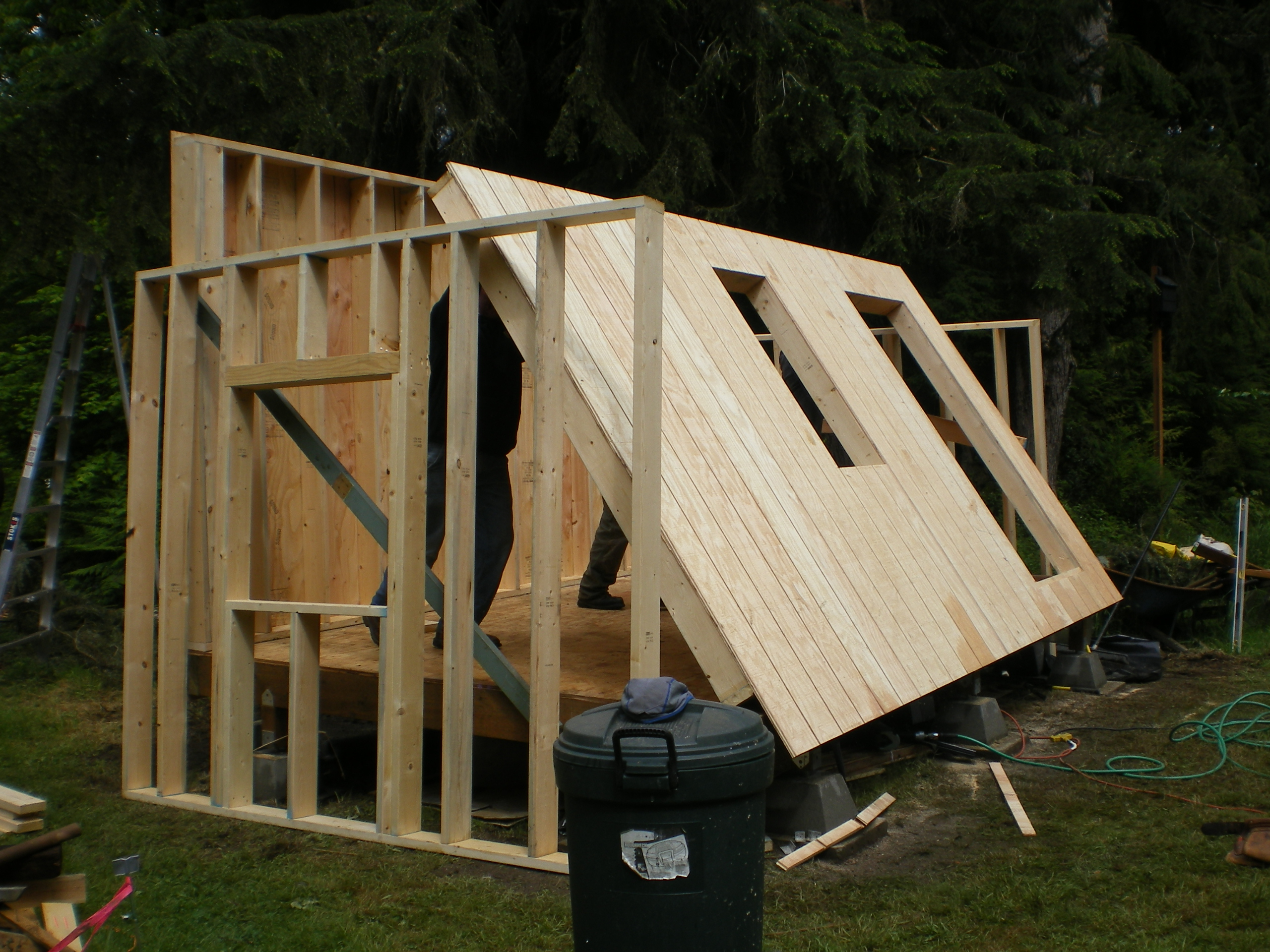
A new office (a.k.a. officeaj mahal) s under construction, a swallow is building her nest in the still-open ceiling joists, a red-headed sapsucker darts back and forth between the insect-rich swamp and her nest tree and rabbits converge on the tender nursery plants from every direction: one lives under the storage shed, one by the big Cottonwood and one under the Quince bush.

My niece Cassie and her sweetie Ty are preparing for their wedding in the field adjacent to the nursery.  They constructed a wedding arch from Vine Maple poles on Sunday.  Family members have painted and cleaned the little cabin where my office has been.  The father of the bride has been leveling, seeding and mowing, mowing, mowing the field.  Wedding planners and decorators wander about with clipboards and measuring tapes.

During a work party last weekend, my brother and the next-door neighbor  conferred about wedding parking while two bears lolled about in the planned parking area.  They didn’t care about the two humans and the idling mini-van.  Work party participants tied up the littlest dog when they learned of the bear siting, but after the cleanup neatly piled all garbage (oopsie) on the patio for later hauling.  One of those bags proved particularly interesting to our ursine residents. I did a bit of Monday morning bear K.P.  Bears really like pizza-flavored paper plates, chocolate and licking meat trays. Not much for onions.

It is fun and interesting, if a bit scary, to have bears in the neighborhood, taking advantage of the natural abundance.  The salmonberries are ripening, and I like the idea of bears eating our salmonberries.  Wait a minute…whose berries are they, really?  Bears don’t care about rules regarding property rights, littering or civilized dining manners (no, no, let Fifi go).  I think they do know which day is garbage day in neighboring Reintree, though!

Civilizing the gardens around the cabin has been part of the wedding-prep duties. Two ivy-covered stumps have long been a source of personal humiliation (they were objects of ridicule for my Native Plant Society colleagues at a meeting a few years ago). Thanks to my big sister April, the Stumps of Shame were finally stripped of their illicit foliage, planted round about with Piggy-back Plants and Lady Ferns, and given a big Goatsbeard as a centerpiece with a little Evergreen Huckleberry on one side.  Today I topped the stumps with a little soil and planted native Sedum and Woodland Strawberry.  I spruced up the overgrown native garden by the driveway, pulling buttercup and pruning Western Red Cedar and Red Huckleberry limbs to give the Scouler’s Corydalis more light.  I added some Foamflower, Small-flowered Alumroot, a Bilberry and some native Sedges.  Gardening is FUN!

Wildlife Plants

The survival of some animal species depends on native plants; native flora and fauna evolved here together.  Providing habitat for wildlife is one excellent reason to plant natives.

Fruits and flowers are important food sources:  flowers provide pollen and nectar for insects and hummingbirds and fruits feed a wide range of animals.

The Cascade or Coast Penstemon (Penstemon serrulatus) blooms all summer with a profusion of purple flowers.  It gets 2-3’ tall and wide, thrives in the sun and seeds itself readily.

In his informative book, Landscaping for Wildlife in the Pacific Northwest, Russell Link says about Penstemons,:  “The flowers attract hummingbirds, bumblebees, night-flying moths, and butterflies including swallowtails, common wood nymphs, and Lorquin’s admirals.”

Cascade Penstemon is showy, valuable for wildlife, and easy to grow.  What’s not to like?  Well…one thing.  The flowers are, uh, stinky.  So grow it, just not by the front door.

Tall Oregon Grape (Mahonia aquifolium), another valuable wildlife plant, is a narrow evergreen shrub with holly-like leaves.  It gets 6-8’ tall and slowly spreads by rhizomes.  It thrives best in well-drained soil in the sun though it tolerates shade also (but will be lanky in the shade).   Both its yellow flowers and pretty clusters of blue fruit are valuable to wildlife (and edible for humans).

Some of Tall Oregon Grape’s specific wildlife benefits, according to Link:  “The berries are eaten by many birds, including grouse, pheasants, robins, waxwings, juncos, sparrows, and towhees.  Foxes, raccoons, and coyotes also eat the berries.  Deer and elk will occasionally browse the leaves and flowers.  Orchard mason bees and painted lady butterflies use the nectar.”

May Day

So, it is Native Plant Appreciation Week.  AND it was May Day a few days ago.  All week long, I have been beleaguered by sign-waving Native Plants.  They are standing tall and proud in the nursery (egged on by the free-range huckleberries in the woods adjacent). 

One of the Grand Firs (Abies Grandis) gave a speech:  “It’s time to take a stand! Haven’t we been downsized enough?  Our hard-working limbs, leaves and roots disrespected enough?”

The Large-Flower Fairybells (Prosartes smithii) straightened their curving stems a bit and waved their creamy yellow flowers. 

Grand Fir continued.  “Those humans have contracted out most of our work!  They dig pits to replace whole ecosystems and claim they will keep the water clean.  Are they doing the job RIGHT?”  Grand Fir paused for a moment to curl a branch into a full-on sneer.  “NO-O-O-O!  How can a hole in the ground do YOUR jobs of cushioning the earth from pelting raindrops and rushing, polluted runoff?  How can a gutter or a storm drain provide a home for a Junco or a Tree Frog?”

At this point, the demonstration took on a surprising degree of diversity.  Scolding noises came from the trees.  A tree frog croaked and the newly-hatched tadpoles in the kiddy pools waggled their tails.  And the little pots of mosses, carrying signs that said “Cushioning is our job!” and “Moss-Out Kills!” and “Solidarity with Peat!” stumped out to the driveway and staged a Moss-In.  The moss on the branches of the tall Douglas Firs (Pseudotsuga menziesii) overhead went wild, throwing lichen bits and hollering.

Grand Fir, encouraged, worked herself up a little more.  “Do they think that LAWNS or poodle-puff-who-knows-what-they-are-supposed-to-be shrubs will really give them what they need?  They need life!  And they get that from us!  WE are the 99%!  Just try to imagine how many plants it takes to keep one of those too-smart-for-their-own-good primates alive?”

“I know, I know!” squeaked a plump baby Vine Maple (Acer circinatum) in a 1-gallon pot, flapping its new, still-soft leaves. 

Grand Fir ignored him.  “Let me tell YOU!  There’s a big debt outstanding to Mother Nature!  It’s high time humans stop taking it out of OUR cambiums!”

The Red-Flowering Currants (Ribes sanguineum) began swaying back and forth, making a deep rumbling (which surprised me, since they are only a foot tall):  “No more bailouts!  No more bailouts!”

Grand Fir raised a limb to silence the somewhat off-topic Currants.  “It’s high time they APPRECIATED us!”

I’ve been hearing this kind of talk all week, and frankly, I have had enough.  Time for these plants to march on out of here.  Time for you to give them gainful employment in your yard, doing water quality protection, habitat support and general environmental cleanup.  And allow them to reclaim some space for Mother Nature.

Don’t be afraid to come—these highly qualified job candidates will welcome your support.  And I will make them put away their signs.

Living on Light & Water

In the throes of doing my taxes last week, I was NOT aware of the beauty of nature around  me, NOT thinking how fresh and clear the air was after the dawn rainstorm.  I was NOT thinking of beauty or health or clarity.  I was thinking about MONEY.  How I HATE it.  How I don’t have ENOUGH of it.  My back to the sun, I stalked across the field, shoulders tense, head down – so I had to notice the brilliant droplets clinging to the blades of grass.  Electric blues, flaming oranges, rubies, emeralds, amethysts and gold; jewels in every spectrum-hue flung themselves at my feet.

“I could live on these,” I thought.  On tiny bright portions of light and water.

Days later, taxes turned in, stress level ratcheted down a few notches (now accepting recommendations for small-business accountants), I realize that I DO live on light and water.  Money is nothing but a disturbing societal invention.  I just need a new business plan.  It is light and water that power me through each day.  The nursery’s plants exist and grow because of light and water.

Light and water have filled the nursery with plants reaching out for more!  The Foamflower (Tiarella trifoliata) has woken up.  Hunkered down flat all winter under the shelter of a big Dougals Fir (Pseudotsuga menziesii), bright three-part leaves stretch up to the spring light.  They will bloom all summer, small plumes lifting up to two feet tall, above the foliage.  The clusters of tiny flowers are white.  Did you know that white encompasses all the colors of the spectrum?  (more on Foamflower)

The Grand Fir (Abies grandis) is responding well to light and water (and weeding, and chip-hauling…).  They have a respectable three-foot start on their future lives as elegant tall members of the ecological community.  If you have a well-drained site, you may consider this evergreen tree.  It will host plenty of life in its beautiful canopy of shiny dark-green needles – and shade the Foamflower.

Living on tiny bright portions (cash helps too)…