Family (Saxifrage, that is) Jewels

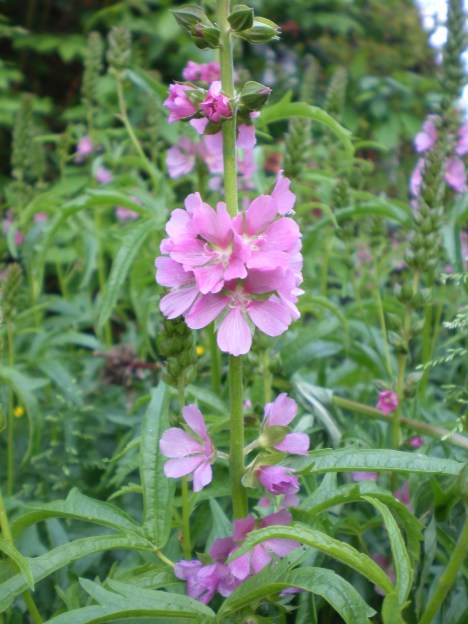
A couple of weeks ago, I bragged about researching Henderson’s Checkermallow (Sidalcea hendersonii). If I had really done “research”, I would have questioned what I already “knew” about that plant. A friend gently mentioned that it is in the Mallow family (Malvaceae), NOT the Saxifrage family. This may not seem a big deal to non-plant-addicts, but this information is supposed to be deeply embedded in my brain. Once again, I am humbled by the voluminous, towering mass of Stuff I Should Know.

Stuff I Do Know: We do have some very nice members of the Saxifrage family abiding at Tadpole Haven.

Several like hanging out in the shade. Leafy Mitrewort (Mitella caulescens), Fringecup (Tellima grandiflora), Foamflower (Tiarella trifoliata) and Piggy-back Plant (Tolmiea menziesii) fit in that category. Fringecup and Piggy-back can even handle quite wet soil. They both have tall (~3’) flowers: Fringecup’s small but numerous flowers are yellow tinged with red; Piggy-back’s are rather plain—its main claim to fame is its lush foliage with new leaves sprouting from the older leaves. Leafy Mitrewort’s foliage hugs the ground. It sends out short runners, forming a lovely carpet from which emerge miniature-periscope-like flower stalks towering an awesome six inches above the forest floor. The green (!) blossoms are exquisite and can inspire perfectly normal people to get down on their hands and knees to enjoy them! Foamflower, even in bloom, only gets about 1 ½ feet tall. The frothy white–sometimes pale pink—flowers appear en masse in spring, but continue to bloom, though less profusely, all summer and into the fall.
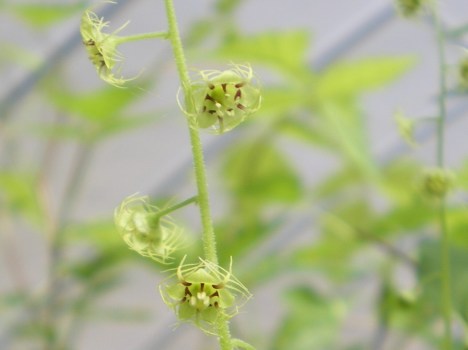
IMGP5121Mitella caulescens cropped

Delicate Flowers of Leafy Mitrewort (Mitella caulescens)


Foamflower (Tiarella trifoliata)
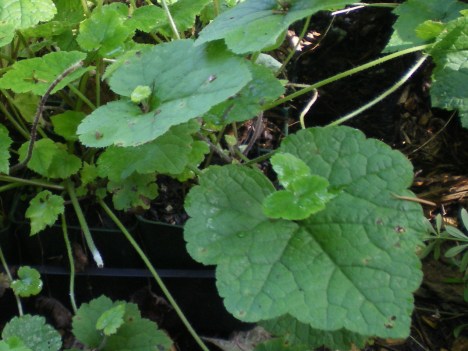
Foamflower (Tiarella trifoliata)


IMGP3882TOLMIEA MENZIESII cropped

Piggy-back Plant (Tolmiea menziesii)

Facts are a Wonderful Alternative

We recently got Cable TV. For years, we have been blissfully out of touch with fear-inducing TV news stories of deadly car wrecks and mini-mart stickups. Seeking to soothe my jangled nerves, I discovered that botanical research calms me and expands my mind and horizons in a chemical-and stress-free manner.

Yesterday I decided to learn more about Henderson’s Checkermallow (Sidalcea hendersonii), also known as Marsh Hollyhock. I like to think that I know something about this perennial member of the Mallow family (Malvaceae). The flower stalks reach much higher than its basal leaves. The bright columns of pink blossoms can be over four feet tall. I know that it does well in moist to wet sunny conditions, but can also thrive in partial shade or in relatively dry soil. Full afternoon sun and sandy soil cause it to suffer – I know — I’m guilty of Checkermallow abuse—lock me up!). It seeds itself prolifically (sometimes you may have too much of a good thing). But I did not know what plants are its natural companions in the wild; I have never seen it in nature!

Though it thrives in a cultivated garden, Henderson’s Checkermallow is surprisingly rare throughout its range (SE Alaska south to Oregon’s coast). In fact , it is classed as rare in British Columbia and Oregon. Perhaps it used to be more common, before human-caused habitat destruction. It grows in a smattering of coastal locations, including at least one site on Whidbey Island, in tidal marshes and estuaries, ditches and meadows near salt water. I learned that researchers had found it growing with bulrushes and grasses, including Tufted Hairgrass (Deschampsia caespitosa). Also with the yellow-flowering groundcover, Pacific Silverweed (Argentina egedii), the Red Elderberry (Sambucus racemosa) shrub and Hooker’s Willow (Salix hookeriana).

IMGP4427 SIDALCEA HENDERSONII

So there you have it! Don’t you feel better? I’ll bet you have momentarily forgotten the increasIng nuclear capabilities of North Korea, the composition of the three-drug death penalty cocktail and the danger of falling prey to a texting driver! Facts are a wonderful alternative!

Mother Nature tries to get our attention

Another week of mud. And recuperating from last week’s windstorm. Mother Nature sure knows how to get my attention – three Cedar trees fell down in the field! So we are still huddling in the greenhouse, where the Camas is beginning to bloom their lovely blue spikes of star-shaped flowers.  They are in an unnatural condition, under cover and in pots..  In nature, you might find some near and around Garry Oak (Quercus garryana) trees in prairie areas (e.g. south of Olympia). They may have as companions the shrub Ocean Spray (Holodiscus discolor), the native perennial Western Columbine (Aquilegia formosa) or fellow bulbs Tiger Lily (Lilium columbianum) or Broad-leaved Shootingstar (Dodecatheon hendersonii).

The Great Camas (Cammassia leichtlinii) is taller than the Common Camas (Cammassia quamash): its grass-like leaves up to 2’ tall, with flower stalks up to 4’ (Common Camas is half that size).  I am anxious to watch them side-by-side to compare how they bloom; I know that the Great Camas flowers open a few at a time, and I want to see for myself whether all the flowers on a Common Camas flower spike really open all at once. I haven’t paid enough attention in the past.

The weather should start to improve (according to the weatherman), so we should respond by getting out into Mother Nature’s realm and paying attention to her small beauties as well as her fiercer glories!

Lilies

March 25

Finally, the Pacific Chorus Frogs are chirping. The swallows are back– which means the insects are back. The swallows dip and swoop in big loops over the lake surface. The Northwestern Salamanders have laid their eggs along the lakeshore. I haven’t actually seen any salamanders yet this year, though I have found a few sluggish newts hunkered down underneath flats of Fringecup (Tellima grandiflora).


The Lily-family plants are poking above the ground: Western Trillium (Trillium ovatum), Large-Flower Fairy Bells (Prosartes smithii),Star-Flowered False Solomon’s Seal (Maianthemum stellata) , Tiger (or Columbia) Lilies (Lilium columbianum) AND White Fawn Lilies (Erythronium oregonum)! Many of the White Fawn Lilies will be blooming shortly. These diminutive showoffs have nodding flowers with pointed petals that curve back. They will be in their full glory shortly, and after their blooms wither and they set seed (and they will probably seed themselves in your garden) their foliage will also die back to nothing by summer. White Fawn Lilies thrive in bright shade, although we have a patch doing well in deep shade under a spruce tree in our yard.

Fern fronds are unfurling as the days lengthen and the temperature creeps up. The Deer Ferns (Blechnum spicant) in the greenhouse are just beginning to develop new fronds. They still have their evergreen foliage from last year, but aren’t quite mature enough to have developed the vertical spore-bearing fronds that makes Deer Fern such a striking plant. They like moist shady areas best.

Spring, Wet or Dry

Hummingbirds are back in full force and big furry baby bees are bumbling about. If you go for a hike, you’ll see Trilliums (Trillium ovatum) in their full glory. Spring must be here! But why are we still slip-sliding through mud? Enough already!

IMGP2319AquilegiaFormosaCropped

So we head for the greenhouse, where we can work in the dry. The Deer Ferns (Blechnum spicant) unfurl their fiddleheads, the Broad-leaved Shootingstars (Dodecatheon hendersonii) tease us with lots of foliage — but are they going to bloom? The Douglas and Pacific Coast Hybrid Irises (Iris douglasiana, Iris sp.) sprout new leaves and several mystery pots declare themselves Skunk Cabbage (Lysichiton americanum)! And good news for bees and hummers (birds not mini-tanks), Western Columbine (pictured) (Aquilegia formosa) is ready to par-tay! No blossoms yet, but healthy blue-green foliage.

Native Plants & Treefrogs: Everything Works Together

Native plants are beautiful and interesting, but they are not an end in themselves. They cooperate with other biological or ecological factors such as climate and geology to create resilient habitat. Everything works together!

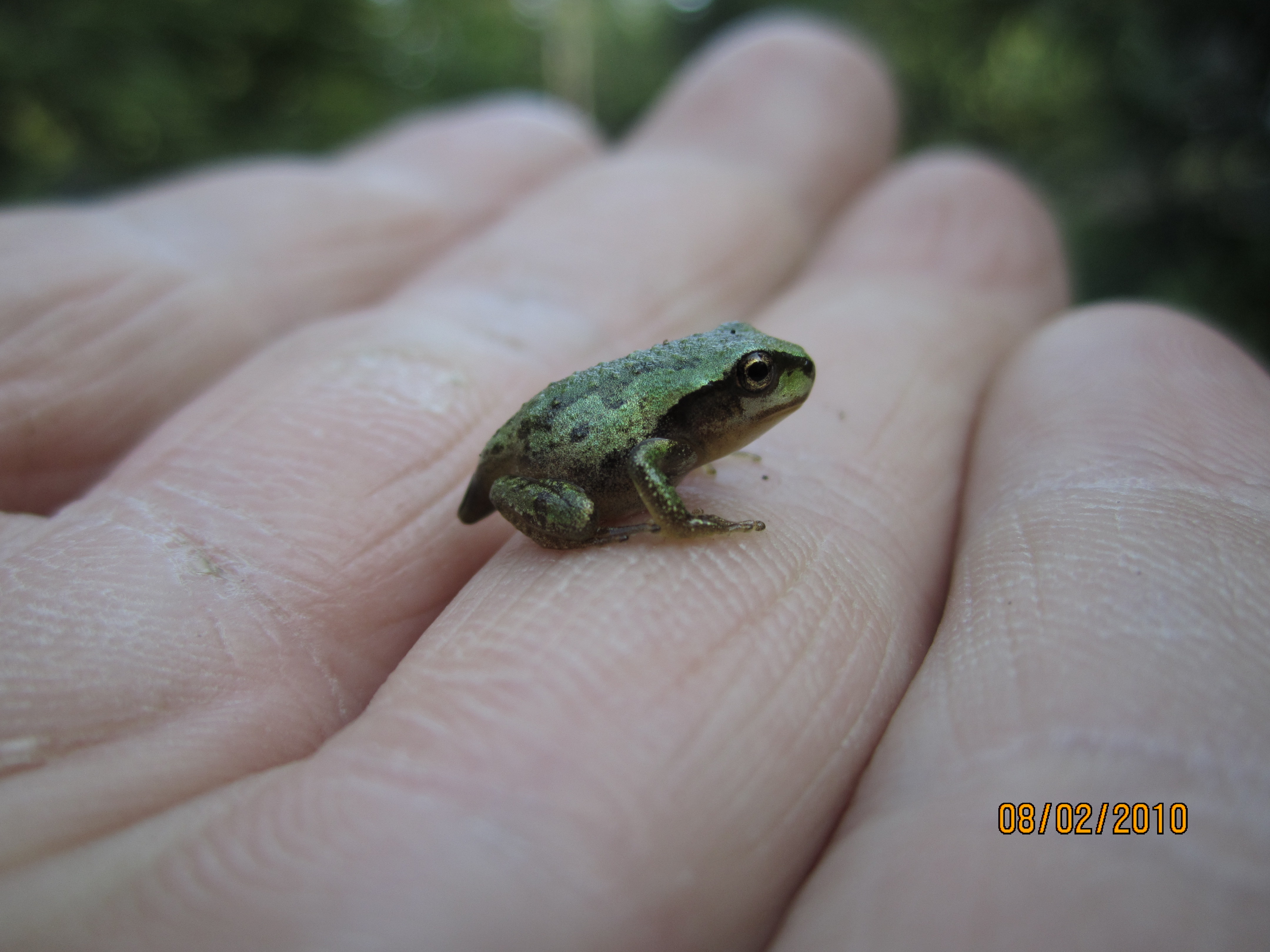
Any day now, the Pacific Chorus Frogs (a.k.a. Pacific Treefrog) will start raising a ruckus in the wetlands around Tadpole Haven. So far, the weather has been too cold for them. They have already begun calling in warmer parts of the Puget Sound region, such as Seattle.

This time of year, they migrate toward water to find mates. The males are the noisy ones! Once they breed, the females lay their brown-and-cream colored eggs in golf-ball-sized clumps of clear jelly on plants and twigs along  sunny, well-vegetated shorelines. They seem to prefer to lay their eggs on thin twigs and stems; sedges, rushes, Marsh Cinquefoil (Comarum palustre), and stems of Red Twig Dogwood (Cornus sericea) that have draped into the water are some common choices.

The ideal pond for Chorus Frog breeding dries up in late summer, making it an unattractive place for the predatory, invasive Bullfrog, which needs year-round water.

But mating season is only part of the story. After the lovefest is over, the adults go back into the forest (or your frog-friendly backyard). And after the tadpoles hatch, grow and metamorphose into tiny frogs, they also hop into the woods. If you can stand in your own yard and are able to hear them calling from a nearby pond, you can provide them somewhere to go during the rest of the year. They will need the native plants and trees growing in your yard in order to thrive. During a Western Washington winter, they don’t hibernate in the classic sense; they’ll seek shelter from the extremes, only going dormant or inactive when it’s really cold out. Throughout the winter, you may hear an occasional low cri-i-i-i-k of a Pacific Chorus Frog in the forest or hospitable garden.*

The Department of Fish and Wildlife has a very informative pdf you can print out at http://wdfw.wa.gov/living/frogs.pdf

Wikipedia has a good entry: https://en.wikipedia.org/wiki/Pacific_tree_frog

*Thank you to Brian Bodenbach of Biosphere Landscape, brian@biospherecompany.com

Riotous Roses And Pussy Hats

I am excited. My friend Linda crocheted me my very own pussy hat, complete with cute pink ears. And on Saturday morning I am going to grab my pussy hat and dive headfirst into the Seattle throngs at the Women’s March. We’ll speak our minds – politely – as a way to encourage each other and to object to (harrible, harrible) domination-based values hurtful to People, Peace and Mother Earth.

Pink is not really my best color but it sure looks nice on a Nootka Rose (Rosa nutkana). Fragrant and beautiful, the Nootka Rose is flagrantly aggressive and prickly. So it’s a wonderful plant in a sunny hedgerow or exposed slope where its rhizomes can spread and form a thicket (terrific shelter for birds).

More ladylike (really only a virtue anymore if you happen to be a plant), the Bald-Hip Rose (Rosa gymnocarpa) also has beautiful pink flowers but stays where you put her. In the Spirit of Mutuality, she won’t run rampant over the smaller citizens of your garden. Definitely a candidate for Miss Congeniality! And she likes shade!

Subalpine Spirea (Spiraea splendens) is a standout shrub that has the virtue of staying pretty short — usually under 4 feet tall. In June, she blooms — dark pink clusters of tiny flowers. Subalpine Spirea thrives in sunny places, as long as the soil has some moisture in it. It will spread, but relatively slowly. Wonderful, wonderful plant. I love that plant.

I’ve saved the most glamorous shrub for last: Western Azalea (Rhododendron occidentale). Like Subalpine Spirea, it does best in sunny, moist conditions. This dignified deciduous beauty will grow up to 8 feet tall. The blossoms are very, very (very) fragrant and delicately tinged with pink, peach and/or yellow. Its natural range is Southern Oregon to Northern California so it is a “Northwest” native (as opposed to locally native).

Hope to see you soon! Your Pinko Purveyor of Native Plants,

Shirley Doolittle-Egerdahl, owner

Tadpole Haven Native Plants

S.A.D.?? Look at our native plants!

I CAN FEEL IT. Seasonal Affective Disorder is setting in. These two sunny days are a temporary respite from the dark. The dark rain. The dark election. The dark afternoons. It’s all getting to me!

Now that the wind and rain have blown the bright yellow leaves off the Big-Leaf Maples (Acer macrophyllum), there is nothing to trick my brain into thinking that the summer light is still here. We have entered the days dreaded by erstwhile Californians — days when the only color you see is the green-and-black of forest rising around.

We are surrounded by evergreen trees, shadowing our winter lives.

Cheer up! That is the way our Western Washington forests should look! A resident of Forks (on the Olympic Peninsula), which annually receives an ungodly 120 inches of rainfall, gave me a hot tip: the Rain Forest is most beautiful when it’s raining! Need open skies? Go for a tromp in a swamp! Need dry weather? During a downpour, stand with your back against a big old Western Red Cedar (Thuja plicata). (Am I sounding so chirpy that you want to slap me? Sorry—two days of sun and I go giddy…)

If the only thing consoling you is the thought of that extra hour of sleep you’ll get on Saturday night, take a look around. Fringecup (Tellima grandiflora) still looks happy, with its deep green ruffled leaves. It hunkers down and stays green during mild winters especially when under the shelter of tall evergreens. Since it readily self-seeds, it acts as a semi-evergreen groundcover, sprouting 3-foot tall stems of cute yellow spring flowers.

And look at all our festive evergreen Sword Ferns (Polystichum munitum)! They look elegant and maaaavelous all year. And as previous years’ fronds gradually melt into the ground, they form a protective “skirt” – high-fashion winter shelter for amphibians such as ensatinas and salamanders, and invertebrates—insects, centipedes, beetles.

So quit huddling in your house and get outside!

What we have in COMMON

Politics, politics, nonstop politics. Partisanship running so hot sometimes even family members have a hard time finding common ground. Sunday I was preparing dinner with my sister-in-law, whose political views I do not share. We talked about family news and grandchildren. She commented on the vase of cut asters on the windowsill. Just then, the beautiful shades of twilight were settling on the field and the nursery beyond.

“Let’s go look at the asters!” I said. “This is the best time of day — the twilight really brings out the colors.”

aster-chilensis2

Common California Aster (Aster chilensis)

And so we left the vegetables on the counter and walked across the field to the nursery to look at the Common California Asters (Aster chilensis*) which are growing in a glorious heap. They are in individual pots but their stems are all intertwined with each other, and they are beautiful. Sure enough, their lavender petals and yellow centers were positively glowing in the twilight. And next to them, uncharacteristically blooming in the Fall, were their cousins, Showy Fleabane (Erigeron speciosus). Besides being spring bloomers, they have slightly darker purple petals and a much shorter growing habit. Like the aster, the fleabane loves sun.

The Common California Aster (native from California to B.C.) blooms in the fall, a welcome break from the depression setting in as the days get shorter and the politics get harsher. Enjoying the beauty of nature together can be that common ground we so badly need to share; suddenly the “Common” California Aster represents precious, threatened community.

The Aster and Fleabane are defying the inevitable autumn decline. Other plants in the nursery still look especially terrific: Deer Fern (Blechnum spicant), Pacific Waterleaf (Hydrophyllum tenuipes),Small-flowered Alumroot (Heuchera micrantha), Henderson’s Checker Mallow (Sidalcea hendersonii) — some are blooming!, 4-inch size Goatsbeard (Aruncus dioicus), Fringecup (Tellima grandiflora), Sea Pink (Armeria maritima), Oregon Stonecrop (Sedum oreganum), Fireweed (Chamerion angustifolium).

In addition, there are some hard-to-find species available: California Wax-Myrtle (Morella californica), Devil’s Club (Oplopanax horridus) and a handful of Bog Laurel (Kalmia polifolia ssp. occidentalis).

8/11/2016 Meteors and Native (Plant) Stars

Did you see the gorgeous half-moon last night?  Sometimes when I take the dog outside at night, I leave the porch light off in hopes of seeing the stars. Last night, the sky was just dark enough to see the brightest stars. The waxing moon, gold and low in the southern sky, presided over the planets Mars and Saturn and the brilliant star Antares (I wish I could brag that I knew that off the top of my head!). It was not dark enough yet to see any of the shooting stars from the Perseid meteor shower. The annual star-show will be at its height in the wee hours of Friday morning—after moon-set. It is slated to put on an extra-spectacular show this year. I’m counting on insomnia kicking in tonight!

Thinking about the heavens as the dog took his final pee on his favorite Sword Fern (Polystichum munitum), I wondered what constellations are named for plants? Are there any? The answer, I learned today, is zero. Of the 88 constellations recognized by the International Astronomical Union, NONE feature plants. Did the ancient Greeks and Sumerians consider even olive branches and grape clusters too mundane, too earthly, for a slot on a sky chart?  Why aren’t any constellations named after PLANTS?

There are plenty of plants named after STARS! A few of our earthbound, ground-hugging, spring-blooming native perennials come to mind: Broad-leaved Starflower’s (Trientalis latifolia) delicate white-to-pinkish stars nod on invisible stems 3-4 inches above the surface of the planet. Star-Flowered False Solomon’s Seal (Maianthemum stellata) is a woodland groundcover whose nebulas of tiny stars hover in earth’s atmosphere, elevated on their leafy stems up to two feet high.  And Broad-leaved Shootingstar (Dodecatheon hendersonii) aspires to the heavens (reaching its zenith at approximately 12 inches). Dormant now, in early spring its bright magenta flowers illuminate the garden.

As long as I’m demanding answers, why doesn’t the shade-loving groundcover Inside-out Flower (Vancouveria hexandra) rate a heavenly appellation? The delicate white flowers have the same shape (albeit smaller) as Shootingstars! The shape of its leaves has earned it the alternate name “Duckfoot” – cute, but the opposite of celestial-sounding.

Tonight, turn off your porch light, look up, and let the heavens inspire you. But today, look down at your feet, and let the heavens-on-earth sustain you.