Earth Day 2016

Today is Earth Day. I hope every day is Earth Day for you. How will you celebrate?

Yesterday on KPLU, I heard an inspiring story:

“Aldo Leopold, in his ground-breaking work A Sand County Almanac, described his family’s efforts to restore their land to its natural state. Leopold’s granddaughter, Susan Freeman, a piano teacher in Seattle, inherited that land ethic.

When offered the chance to help restore a watershed on Western Washington’s Olympic Peninsula, Susan and her husband Scott couldn’t wait to dig in. Together with fellow land-owner Peter Bahls, the Freemans are restoring the five-mile-long Tarboo Creek. They’ve planted more than 10,000 trees so far. What inspires someone to put so much time and energy into a piece of land? Let’s hear from Susan: ‘Planting a tree to me represents being able to do something for future generations, the way my grandfather and my father have done for my generation and my kids.’”

For more: http://birdnote.org/show/restoring-land-interview-susan-freeman  (BirdNote began in 2004 as a project under the auspices of Seattle Audubon).

Everyone that thoughtfully plants native plants is part of the effort to restore native ecosystems.

Come participate in the healing of our earth.

Native: Proud to Be Green and Obscene

What self-respecting gardener says green isn’t a color? I dare that person to walk outside this time of year and say that out loud. There are more colors of green in our yards, forests and parks then there are colors in a big box of crayons.

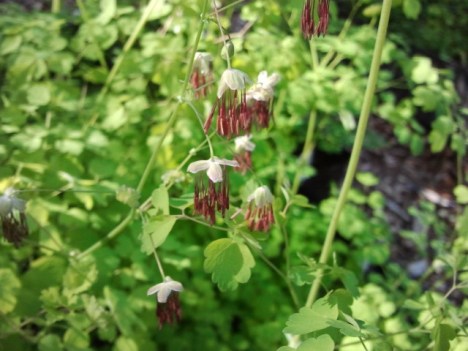
One of those hues, a shade of bluish green, colors the delicate foliage of Western Meadowrue (Thalictrum occidentale). Western Meadowrue is a beautiful tallish (up to 3 feet) perennial that spreads by rhizomes. The male flowers are on separate plants from the female flowers. The small flowers are not showy from a distance but the male flowers are downright glamorous up close.

SAMSUNG

Western Meadowrue (Thalictrum occidentale) male flowers

The female flowers look like pink-and-green fuzz-balls, while the male flowers’ dangling purple anthers that quiver in the slightest spring breeze resemble tiny chandeliers – the kind of fringy chandeliers that you might find in an 1890s brothel . That’s only fitting! It’s all about sex this time of year – plant sex anyhow.

Western Meadowrue grows in bright or partial shade to mostly sun. It is fairly adaptable to moisture conditions and can handle fairly dry (shady) conditions to moist areas such as beside a stream. Western Meadowrue would be quite happy underneath a Vine Maple (Acer circinatum) or Big-leaf Maple (Acer macrophyllum) tree. Fringecup (Tellima grandiflora) would happily keep company with Meadowrue, and I have seen it growing in the wild with Baneberry (Actaea rubra), which is an unusual perennial that gets bright red (unfortunately poisonous) berries. If you want to have truly fulfilled Meadowrue, be sure to procure both genders so they can make babies! Give it some space so that it can spread: by rhizomes or seedlings.

Plant Me, You Fool!

It’s April Fools’ Day, and not too early for spring fever. I have an overwhelming urge to lie down next to the dog in the gravel outside the office and sleep in the sun. But the plants in the nursery are talking too loudly: “Plant me, you fool!” Hanging out in the sun with me, I find three plants particularly relatable: Ocean Spray (Holodiscus discolor), Roemer’s Idaho Fescue (Festuca idahoensis ssp. roemeri) and Oregon Stonecrop (Sedum oreganum).

The Ocean Spray is nicely sprouting its scalloped leaves. A lovely big shrub (9-12 feet tall), Ocean Spray loves full blasting-hot sun in the summer, but can also handle partial shade. Blooming in June, its graceful long clumps of tiny creamy-white flowers make it look like it’s covered in bridal bouquets. They attract tiny pollinators which in turn attracts birds. The flowers fade and hang on through the winter, which many people enjoy as “winter interest” and many insects continue to enjoy as “habitat”.

The other two talking plants make appropriate companion plants for Ocean Spray. These two perennials, Roemer’s Idaho Fescue and Oregon Stonecrop both enjoy the same conditions as Ocean Spray: well-drained soil, sunny and even hot. A clumping grass, Roemer’s Idaho Fescue has gray-green, almost bluish, very fine-textured leaves. Between the clumps of Fescue, low-growing (3-6 inches) Oregon Stonecrop finds space to creep. It is a succulent with plump round leaves that turn from bright green to bronze late in the summer. Its yellow umbrella-like clusters of flowers contrast nicely with the Fescue and provide nectar for bees and butterflies.

Come enjoy a little spring foolishness and see if these plants speak to you! (“Plant me, you fool!”)