Summer survivors

Rain!

The nursery plants are heaving a collective sigh of relief:

“Aaaahhh!  No substitute for pure, fine, generous rain!  Especially when our roots are hostage inside a hot black container and the people who are responsible for our unwilling domestication are not noticing our suffering!  But in spite of neglect and the indignity of captivity, we have survived another summer in Tadpole Haven Gulag.  And – Dang! – we look GOOD (well, most of us).”

“The fact is, us natives are MADE to handle the long dry spells we have every summer (though it is a challenge when our roots are hampered by being in a pot).  Free us from our captivity and we’ll really show what we’re made of.  But remember, we each have our niche where we thrive!”

Well, maybe I’m hearing things, but that’s what the plants are saying to me (it’s been a quiet summer — I must be short on human contact).  And though I didn’t like being accused of neglect, I agree with them that they look good, mostly.

It’s a little early for fall color and falling leaves, and right now some of our most dapper prisoners denizens are several evergreen shrubs and groundcovers that thrive in some of the driest conditions known to western Washington gardeners:  the parched, sometimes dark, shade of tall evergreen trees.  We’ve got four especially beautiful natives that thrive where others perish:  Evergreen Huckleberry (Vaccinium ovatum), Cascade Oregon Grape, (Mahonia nervosa), Sword Fern (Polystichum munitum) and Salal (Gaultheria
shallon
).  This foursome is an adaptable set, able to handle variety of conditions.  It’s nice to have these evergreens as part of a landscape:  they look good all winter, and provide a good contrast with  the changing hues of native wildflowers and deciduous trees and shrubs.  I got some of these internees residents to pose for a group hug:   IMGP4839evergreens

Green Change

I hope you are enjoying your summer.  Summertime brings the blooms of Showy Fleabane (Erigeron speciosus).  Penstemons (Penstemon serrulatus) in the garden are also in full bloom and the bumblebees love them! 

Summertime is also when weeds, pests and diseases catch up with some of the nursery’s plants.  At Tadpole Haven, we are in the business of healing a damaged environment.  It doesn’t make sense to grow native plants (which will be planted as agents of ecological healing) in a way that CAUSES damage.  Most nurseries use chemical fertilizers, hormones and pesticides, which enables them to produce beautiful-looking plants quickly and efficiently.  This is standard practice, but I hope the “green” industry begins to re-think this.  Things happen more slowly at Tadpole Haven where we use organic solutions.

 We weed the nursery plants and beds by hand (no herbicides), which is time-consuming, as any good gardener knows! Plants in containers are in an artificial state, which often makes them vulnerable to pests or fungal diseases. When we run into some kind of pest problem, we find ways of changing the way we care for them; perhaps we’ve given them too much water or maybe they need a different location within the nursery. We don’t rely on herbicides, fungicides and other pesticides. We look at most “diseases” and “pests” as part of the environment and try to give them few chances to get out of balance. But a few spots or nibbles? Not usually treated as a big deal, but as a message from the plants. This organic approach results in birds, amphibians and insects using our nursery as habitat!  And it’s a healthy place to work, too!

Henderson’s Checkermallow

In our yard, bees and butterflies love the colorful bright pink flowers of Henderson’s Checkermallow (Sidalcea hendersonii).  Also called Marsh Hollyhock, it blooms all summer.  The foliage is glossy green and its leaves have two different shapes; the stem leaves are more divided than the scalloped, rounded basal leaves.

Henderson’s Checkermallow is rather rare in the wild (it is on the “Watch” list of the Washington Natural Heritage Program), growing close to the ocean and Puget Sound from southern BC south to southern Oregon.  In nature, it usually grows in wet areas like tidal marshes and wet meadows, though can occur in drier locations.  It is EASY to grow in the garden in full sun to light shade and often seeds itself.  I have one growing in very well-drained soil and it is doing well, though maybe won’t get as big as it might – 4-5’ – in a wetter place.

Go play outside!

Appreciating Tadpole Haven’s Habitat

May Day is almost upon us, and the nursery is MUCH calmer than last year.  I’ve heard no rumors of a Moss-in this year.  I guess all the plants are feeling appreciated – it IS Native Plant Appreciation Week!  

Tadpole Haven’s plants get plenty of appreciation right here from all the little creatures that make Tadpole Haven home.  In the last week or so, Lisa and I have found a couple of Rough-skinned Newts and a Long-toed Salamander hiding among the plant pots.  Our nursery provides a good home for native critters.  It is hospitable partly because we don’t use toxic chemicals or “hot” chemical fertilizers on our plants.  These amphibians appreciate the fact that most of the plants sit on a bed of wood chips that is ever in the process of breaking down, enriching the soil and providing “habitat” for fungi, worms, beetles and other small invertebrates (many of which the salamanders and newts eat for lunch!).

 The Pacific Chorus Frog eggs have hatched, and the tiny tadpoles are visible along the edges of their kiddy pools.  The Mason Bees are becoming more active, laying eggs in their house and stashing nectar and pollen with the eggs for the larvae to eat.  They gather nectar and pollen from the nursery plants and native plants around the adjacent fields and woods.

 This morning I opened up the greenhouse and discovered that a hummingbird had spent the night.  It must have come in yesterday afternoon seeking nectar from the Great Camas (Cammassia leichtlinii), which is in beautiful full bloom, and the Upland Larkspur (Delphinium nuttallii), which has started to flower.

 And other birds are appreciating the native plant habitat in and around the nursery.  I am always seeing Juncoes flitting along low to the ground, in among the nursery pots.  And the Varied Thrushes have been serenading all day long from the big Douglas Firs (Pseudotsuga menziesii) and Western Hemlocks (Tsuga heterophylla).

Ciscoe & Corydalis

Check out these links: Tadpole Haven in The Herald AND Ciscoe comes to Tadpole Haven!

Lots of excitement at Tadpole Haven in the last couple weeks!  First, we were featured in the Home and Garden section of the Everett Herald (March 21).  Then, last week, the producer for KING-TV’s “Gardening with Ciscoe” called and asked if they could shoot portions of an upcoming episode at Tadpole Haven!  The next day! 

After the arrangements were made, I hung up and told my co-worker Lisa about our upcoming brush with fame.  She screamed (she denies it, but I swear she did) which is probably what knocked me to the greenhouse floor in a fetal position with my hands over my head.  We struggled to pull ourselves together and decide what to clean up first.

The “shoot” was fun and interesting to watch.  Thank goodness they didn’t interview me.  Hosts Ciscoe Morris and Meeghan Black, Producer Anne and Cameraman Tom were all very friendly and Ciscoe even let ME interview him afterwards (my son Erik came equipped to record this event for posterity).  They admired the ready-to-hatch frog eggs in the kiddy pool, and Ciscoe gave a plug for our new coolest plant, Scouler’s Corydalis (Corydalis scouleri).

Tadpole Haven will be featured on “Gardening with Ciscoe” THIS Saturday, April 6 and Saturday, April 20, 10 a.m. on King 5.  It replays on Saturday 1:30 p.m. on Kong 6/16 and Sunday 11:30 a.m. on NWCN.

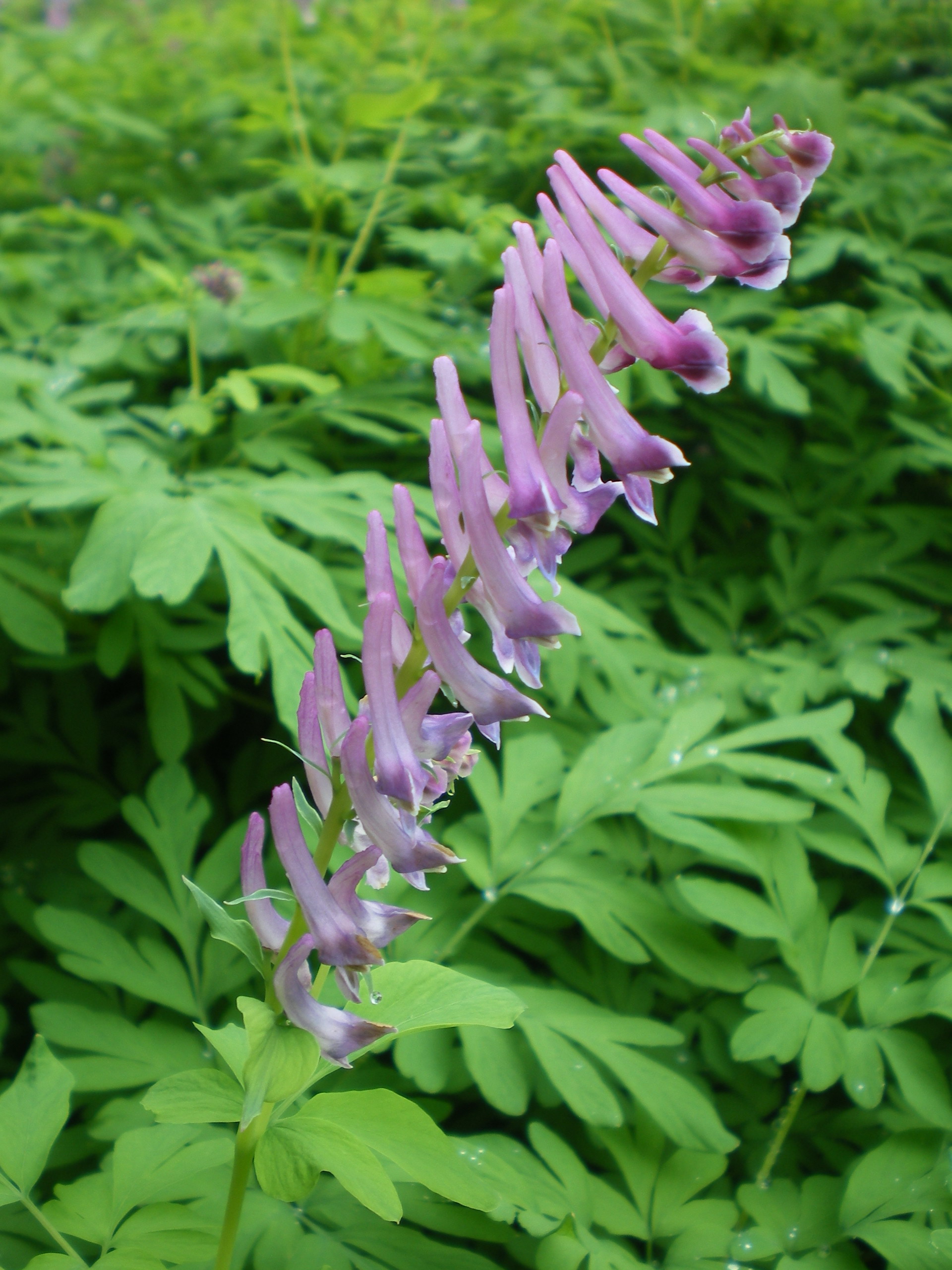
Want to know more about our new coolest plant?  Scouler’s Corydalis is a big gorgeous perennial closely related to Bleeding Heart (Dicentra formosa).  It has delicate ferny blue-green foliage and 4-6” pink towers of flowers.  Happiest in bright shade and moist soil, it will grow to over three feet tall, and spreads via underground rhizomes.  So give it some space of its own where it won’t overwhelm neighboring perennials.  The Scouler’s Corydalis in our front yard attracted a large White-Lined Sphinx Moth to its flowers one evening, a beautiful glimpse at one of nature’s partnerships.

Enough of moth-and-flower love; I’ve got a date with some brussel sprouts.  Ooh-la-la!

Building Resilience

Home sick today, feeling weak and useless. It was even difficult to cut up  macaroni ‘n cheese. Perhaps I wouldn’t feel so lousy if I were in better physical shape. I’m still recovering from breaking my leg on New Year’s (sledding—it was fun!), so I’ve had a couple months of limited physical activity. I really am weak — so not as resilient as I should be.

 “Resilience” is a new buzzword. Everyone from doomsday “preppers” to those in the “Transition” movement to ecologists like to use that word. Are we buffered enough against shocks, whether natural, economic or climatic?

 Preppers advocate being ready for economic shocks and along with the Transition folks, encourage people to learn basic, common-sense skills like canning and gardening. And natures resilience can also be improved  by repairing some of the human damage.

The blustery weather this morning made me think about climate change. Oh brother, this is really hurting my head. How resilient is the natural world to challenges, whether natural our human-caused? I’m afraid that human abuse of ecosystems has reduced nature’s ability to bounce back. Just one teensy example before I reach for the Tylenol: the chytrid fungus is killing frogs. Their populations are already damaged due to habitat loss. Do they have enough resilience to absorb losses from disease?

We are part of the ecosystem.  Planting native plants – building resilience — is one simple common-sense way to help buffer our local ecosystems.

Call the Vice Squad?

Have you been noticing all the birds returning?  And soon our native bees will  emerge.  Hummingbirds will be coming through on their annual pilgrimage north. Is your garden ready with native plants ready to bloom right when their nectar is needed?  What a coincidence! 

The flowers have made a deal with their long term friends, the bees and hummingbirds:  “I’ll give you my delish, nutrish nectar if you’ll help me get a date with that flower over there; here just carry some of this magic dust with you…”

Whether you call it love or sordid botanical scheming, we can all join in the FUN!  Just make sure your yard is full of native plants, ready for action. You can even host native bees!  And tell your neighbors not to call the vice squad—nobody’s getting hurt here.

Some early bloomers that need the hummingirds and bees:  Cascade Oregon Grape (Mahonia nervosa), Tall Oregon Grape (Mahonia aquifolium), Red-Flowering Currant (Ribes sanguineum), Indian Plum (Oemleria cerasiformis), Salmonberry (Rubus spectabilis).

The Power of a Raindrop

If you need free entertainment on a winter day in Puget Sound Country, you can always watch raindrops landing.  I was doing just that a few days ago.  It was so fun.  And exciting.  Like reality TV, only smarter.  They were big heavy drops landing in a pond and I could actually see the vertical splashes and the sideways waves.  There is a lot of force behind a raindrop. 

 Water–accumulated raindrops–has to go somewhere; if it isn’t stopped, it will rush into streams and lakes and Puget Sound, carrying pollutants from our streets and lawns with it.

 Native plants disperse the energy, preventing erosion, and allowing rainwater to filter down into the soil, recharging aquifers and providing summer water for streams.  Some of the best plants for taming the power of raindrops are available at Tadpole Haven.

 Evergreen trees, shrubs and groundcovers are extremely useful in dissipating that energy.  Because they still have leaves or needles during the rainiest months, the raindrops don’t hit the ground with full force; by the time the water gets to the ground, it is calmed, slowed and more easily absorbed.  In fact, a large percentage of the rain falling on a forest dominated by evergreen conifer trees–up to 50 percent—is held in the canopy and eventually released back up into the atmosphere (oh goody more rain), never hitting the ground at all!

 Two evergreens:

  • ·         Grand Fir (Abies grandis), a tall conifer witih shiny deep green needles.
  • ·         Tall Oregon Grape (Mahonia aquifolium), a narrow-growing shrub with holly-like leaves, yellow flowers loved by hummingbirds and edible (though tart) berries.  This is a good choice for stabilizing sandy slopes; you can see it doing its work high on bluffs around Puget Sound

 Four Plants that can deal with soggy spots:

  • ·         Cascara (Rhamnus purshiana), a small tree, has berries that birds love.  If it’s growing out in the open, it has a round spreading canopy; in the forest among tall conifers, it tends to grow straight up toward the light (up to 30’ tall).
  • ·         Piggy-back Plant (Tolmiea menziesii).  You know I love piggys (see In Pursuit of the Piggy-back).  They are a fun shade loving perennial.
  • ·         Large-leaved Avens (Geum macrophyllum) loves sun, moisture, butterflies and your socks (the seeds like to glom onto anything you’re wearing that is fleecy and use you as a seed distribution vehicle.  It has cute yellow flowers and because it is good at spreading its seeds around, it is a good pioneer plant in disturbed open areas.
  • ·         Goatsbeard (Aruncus dioicus) likes to be beside, but not right down in, wet spots like streams, seeps and rain gardens.  It is usually found in the shade (not always near a wet spot), but if it has access to moisture most of the year (your soggy spot), can grow in very sunny places.

 Two other species to help temper the force of our winter rains:

  • ·          Thimbleberry (Rubus parviflorus) does well where it gets some shade, say, on the edge of a grove of trees.  It would be a good choice for a slope; its spreading rhizomes bind the soil together, keeping it from slumping and washing away from the power of raindrops.  Thimbleberry forms a thicket, with pretty white flowers in spring and yummy berries in the summer.
  • ·         Garry Oak (Quercus garryana) will grow up to be a mighty, spreading tree, with roots to match.  It does best in areas that drain well; it won’t thrive in soggy soil.·

Seeds in the dark time

December. The darkest part of the year. The rich and beautiful greens in the forest turn to black by late afternoon. But the proud little Grand Firs in the nursery cheer me like fine Christmas trees. The lingering leaves of the Thimbleberries glow like a congregation of candles. And someone has turned on all the moss – on the rooftops, up in the tree branches, beside the path, in the lawn — the LEB*s are all aglow. The Snowberries are the only snow in the nursery – suspended on nearly-invisible twigs, the brilliant white berries ornament the day like stationary snowflakes.

In the greenhouse, a bowl of bright red berries from the Orange Trumpet Honeysuckle awaits my attention. The berries are bursting with seeds, waiting to be spread in flats and placed under the big Western Hemlock mother tree. There they will sit until inspired by lengthening light-time that will begin after we turn the corner of the Winter Solstice. And in the dark soil, they will sprout.

May the holidays lighten your winter lives and may the New Year find you planting bright seeds for your future.
.
.
.
*Light-Emitting Bryophyte

Unrest in the Forest

“There is unrest in the forest

There is trouble with the trees

For the maples want more sunlight

And the oaks ignore their pleas.”

Brian* has been driving me a little nuts lately humming this Rush tune.  The ballad goes on, neither side giving ground, and the whole forest has a bad end.  We had an extensive ideological discussion (e.g. Did Neil Peart compose this song with Ayn Rand’s philosophy in mind?).  Kind of a tough way to wake up on a Sunday morning.   My take-away: these lyrics illustrate dysfunctional community.

Luckily, the Big-Leaf and Vine Maples get along fine with the Garry Oaks at Tadpole Haven.  Actual native plant communities change and grow relatively harmoniously, adapting to disruption and allowing for natural succession.  In the forest near the nursery, Western Hemlock, the most common large tree, shares the limelight with Sitka Spruce on the wetter north edge and Western Redcedar and Douglas Fir on the drier southern edge.  Underneath grow a wide variety of shrubs and small trees.  Even in the wettest areas, Salal and Red Huckleberry thrive up on hummocks and stumps next to Cascara and Oval-leaved Huckleberry, plants that love the wet.  This “plant” community is of course part of a larger community of life – home to amphibians, hawks, pileated woodpeckers, squirrels, bobcat and coyote.

Communities function properly only if each member helps the other members meet their needs.  A forest is a beautiful example – from the fungi that enhance the tree roots’ ability to absorb nutrients to the old hemlock snag that harbors insects that the woodpecker feeds on.

Humans are part of our forest’s community also.  It has been logged at least twice.  My cousin harvests firewood.  I gather seeds and cuttings.  My children and nieces keep a trail open for us.  The road along the southern edge and hundreds of daily commuters are also part of this forest community.  Most of the commuters are oblivious to the forest community they are part of, but they still affect it and are affected by it.

Humans are part of communities of nature.  One way humans help communities function better is by planting native plants.  Even a small-scale plant community in a backyard builds ecological health and resilience.  Native plants provide services such as filtering runoff from roofs and roads and shading and cooling rivulets and streams, which keeps oxygen levels high for fish and other aquatic animals.  They provide homes for pollinating insects valuable to agriculture.  They provide habitat for wildlife and birds.  Less tangible are the spiritual benefits; a patch of native plants in an urban area is an oasis apart from concrete and lights, for example.

Speaking of community, the election ends today.  Hopefully, all our government officials will now act like members of a forest community and work for the common good.  As for me, after a few days allotted for wound-licking and/or gloating, I will again enjoy the company of friends and relatives I’ve been avoiding during this “silly season”.  I will TRY to be a good community member, accommodating others’ needs and quirks ;).


*Brian Bodenbach,owner of Biosphere Landscape Company