Air change

The air has changed.  I already feel nostalgia for summer.  Every year as summertime draws to a close, one particular summer morning, I feel the change.  The air heralds the change:  the chill in the early-morning fog, the clarity of sound, the vibrancy of greens and yellows in the sideways sunlight.

The swallows are out in force catching insects on the water’s surface.  Six perch on the bench and the rowboat as I approach so close I can see the narrowness of their necks and the shininess of the feathers on their heads and wings.  One has a silver thread arching from its beak – they have been chowing on spiders.

The spiders are more active now.  The path up to the mailbox is blockaded by a dozen webs.  I pull a bracken fern and hold it in front of my face as a web-clearing device so I am not strung with webs (and their weavers) by the time I reach the top.

I demonstrate this practical technique to my friend Debbie; her response surprises me.

“I like the way spiderwebs feel on my face.  It makes me feel caressed.”

Caressed.  The word is an invitation to change.  And allow a small thing in nature that my tidy, insular self usually resists – to bless me.

Bird Haven

June 21

robins, June 16

FEED me! June 16 June 21

June 18

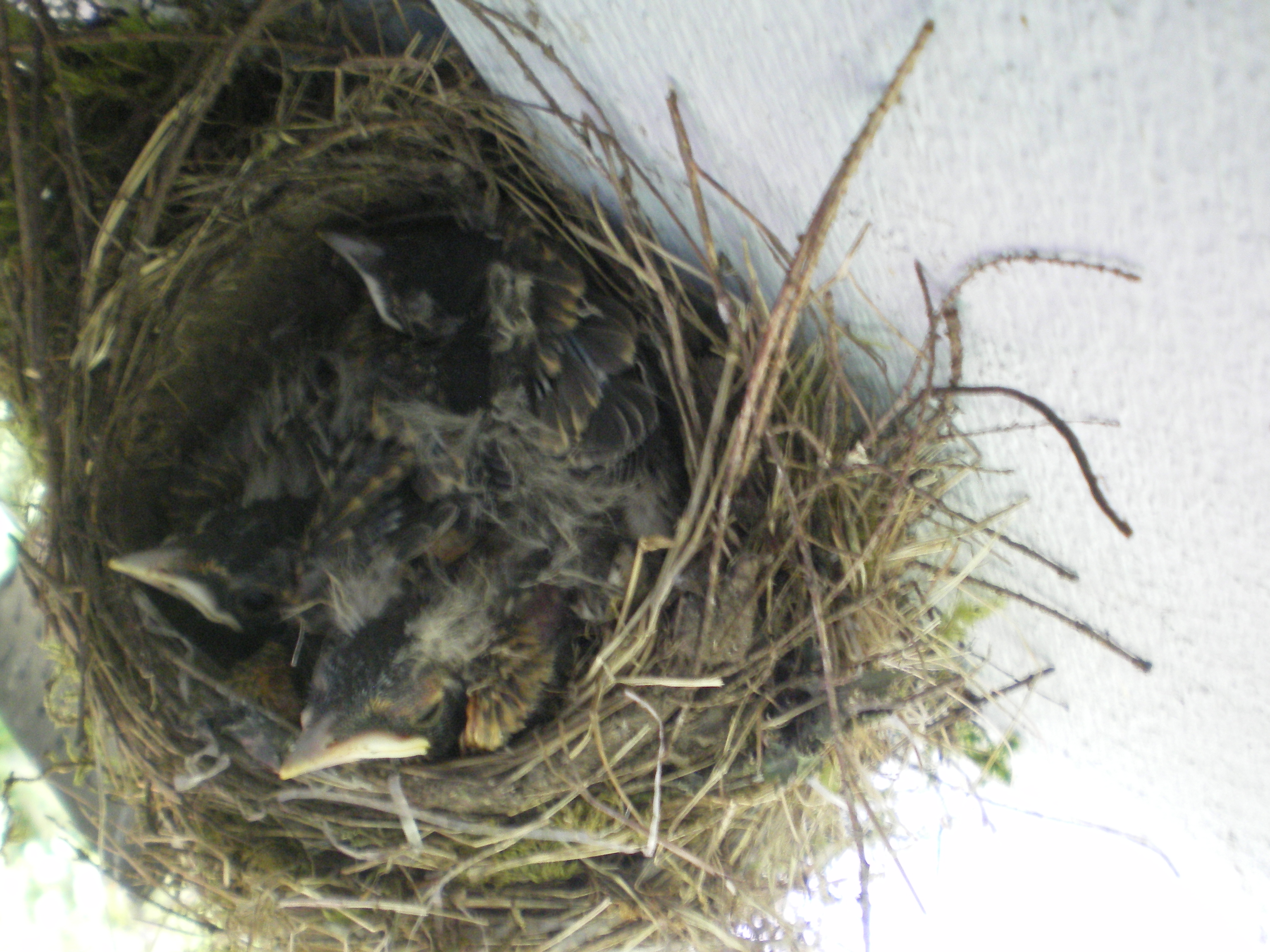
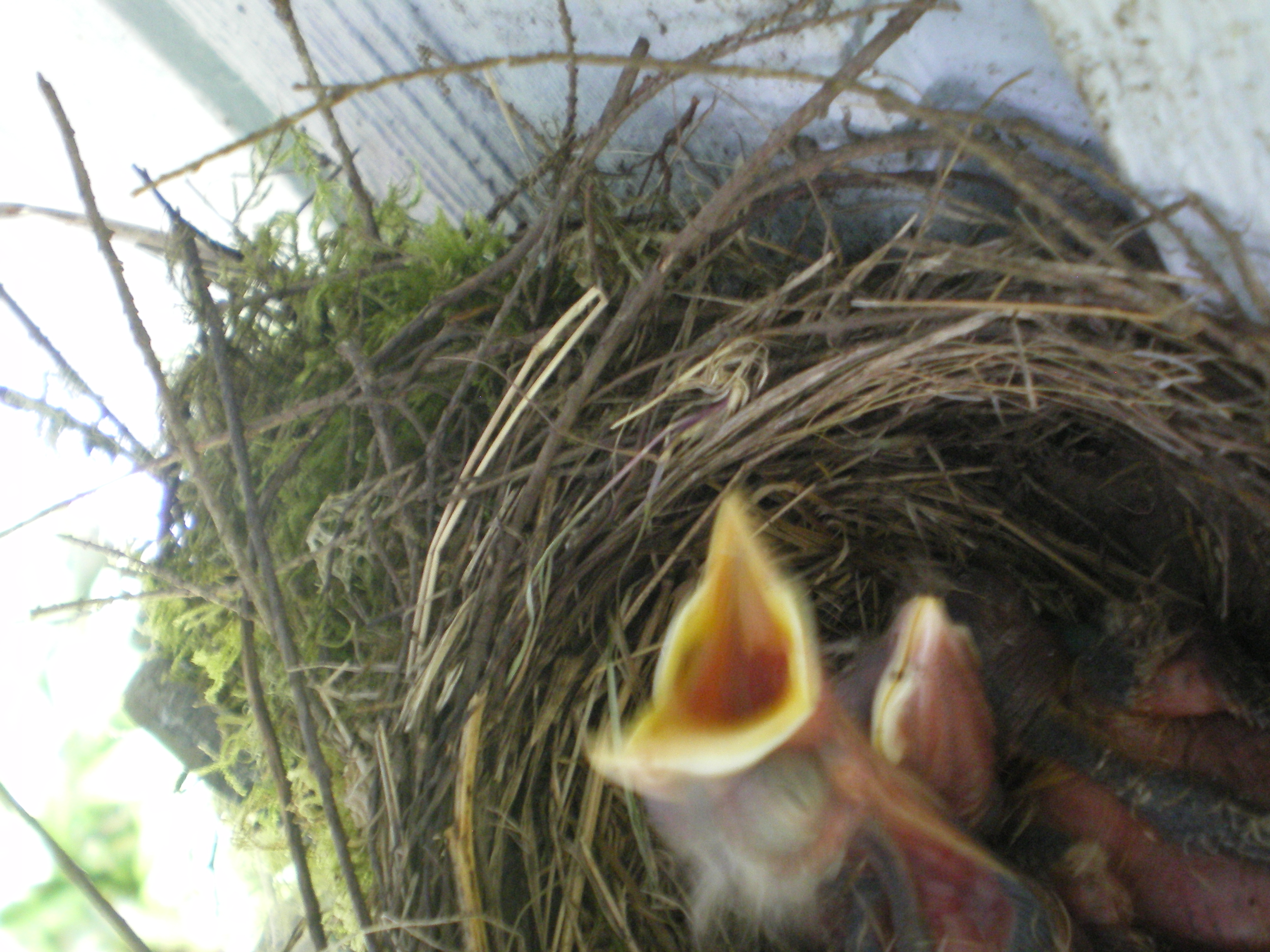
Just a quick update on birdlife in and around the nursery.  The robins that built their nest on the porch light have 3 babies  (there were 4 eggs – one didn’t develop all the way and I found it under the nest today). A hungry raven was hanging about one day, but I successfully scared it off.  There is a second robin’s nest – right in the middle of the nursery in a big elderberry bush. Haven’t seen any babies yet.

 There is also a junco who for the second year in a row, has built a nest among the stack of pots.  Last year, the nest was closer to the ground and something got all the eggs.  This time the nest is higher; so far so good!  The mama is very brave and won’t fly off her eggs until I am just a few feet away.  Then she alights close by and tries to get me to chase her. If that doesn’t work, she flies into the Bigleaf Maple sapling that shades the field growing beds.  She fusses: “Chit… chit… chit… chit!” 

 As these babies get ready to fledge, I’ll have to keep PJ, my Springer Spaniel bird dog/compost turner on a leash, I think.  She already caught two fledglings earlier this spring.  A tragedy, but I couldn’t punish her for doing what she was bred for!  She was so proud of herself.

 I’ll be working out a schedule of Open Days for July and August shortly.  Check the website, or ask to be put on my email list for updates. — Shirley

The weather is about to break

The weather is about to break.  It has to, or we’ll all go insane!  Hopefully we’ll have a sunny day on Saturday (June 12) for Picnic Day.

A lot has been happening at Tadpole Haven.  Many more plants are ready than just a month ago:  Smith’s Fairybells, Orange Trumpet Honeysuckle, Waterleaf, Serviceberry and more. We’ve got a new Bat House – it just needs some summer residents. The Robins are on their second brood – the first didn’t make it, nesting on top of the cabin’s porch light. Our plants are growing very lush (check out the Wood Ferns, Lady Ferns and Inside-out Flower).  The pollinators are busy (bees et al on the Waterleaf, flies and beetles on the Goatsbeard – anybody know the species?).  The Chorus Frog tadpoles hatched a while back and like to hang out around the sides of their kiddy pool.  And we’re trying something new to help shade the nursery this summer: vegetables!  Why not?  We’re watering anyway.  Though it’s hard to imagine right now, some parts of the nursery get blazing hot in the summer, which really stresses many plants.  We’re planting beans, peas and corn in strategic places so they will provide shade – I hope they are tall enough by July to do some good.

It’s been pretty good weather for native plants, though I have seen a little more fungus activity than normal — spotty leaves, for example.  If a plant  in your yard – native or “exotic” – seems to regularly suffer from some kind of fungal disease, it is probably not in the proper conditions.  At Tadpole Haven, we generally don’t treat our plants for a minor fungal problem. We don’t use fungicides.  We may trim off the infected foliage to keep the fungus at bay.  And if a plant or a group of plants in the nursery is really threatened by some fungal pest, we’ll try putting them in a different location, either out of the shade so they get more heat and light, or under the trees or hoop house cover where they will be drier.  It seems to be a wise nursery practice to not put all the pots of one species together in one place – that often prevents a fungus from spreading.  Plants in containers have special needs – they are more vulnerable to any kind of disease or pest or weather extremes.  Maybe I should baby them, but I don’t.  I often call Tadpole Haven “Boot Camp for Native Plants”.  If they survive here, they should do great in your garden!  I think that’s actually true.

Fern Power!

The Wood Ferns are beginning to stretch open, reaching their blue-green fists to the sky as if they are making a stand for Fern Power.  Maybe I should be using another common name for this fern: “Spiny” Wood Fern.  I dropped that because the name frightened people, and there is nothing spiny about it, as far as I can tell.  Maybe its attitude.  “Fern Power!”

 The Wood Fern (Dryopteris expansa) grows big, as big as a Sword Fern, and tolerates fairly dry shade.  It is easy to confuse with the Lady Fern, but it tends to be a deeper, bluer green, and the fronds are triangular, with no frondlets on the lower part of the stem.  It also stays green through most of the winter.  It grows in a clump like Lady and Sword Ferns.  In the forest, you often see it beside Sword Ferns, though perhaps up on a rotting log where it won’t be out-competed by the Sword Fern.  Vine Maple, Western Hemlock, Salal and Cascade Oregon Grape are other companion plants.

 Fern Power.  Ponder the power of a fern, or a forest of ferns and their friends. The calm that settles over your soul when you put yourself in their power soothes and strengthens.  The Wood Ferns unfold their fists and open themselves to light and breeze.

Audubon Sale coming!

It’s beginning to look like Spring.   Many of our plants are waking up after winter.  The fern fronds are starting to poke their heads up, and the Fringecup is lush-looking.  The Chorus Frog eggs in the kiddy pool are waiting to hatch, though in the evening the frogs are still calling, so the Tadpole Haven Dating Service is still active.

 At Tadpole Haven this week, we are gearing up for THIS Saturday, April 3.  We are bringing our plants to the Seattle Audubon Society Spring Plant Sale, 10-4, 8050 35th Ave. N.E., Seattle.  See you there! 

 Our next Open Day at the nursery is Saturday, April 10.

 Did you hear yesterday’s “Weekday” on 94.9 KUOW?  The program featured Heidi Bohan, speaking about edible native plants.  Heidi will lead a Tadpole Teach-in on April 25 at Tadpole Haven.  To listen to yesterday’s radio program, click here.

Open Day Fun

Our Open Day on Saturday, March 20, was a rip-roaring success!  Lots of people came to look at plants and attend the Tadpole Teach-in.  By the end of the seminar, presenter Brian Bodenbach and the rest of the group had bonded into family, learning about the needs and habits of various wild critters.  They studied the Chorus Frog eggs in the nursery’s kiddy pools and walked down to the lakeshore to check out Northwestern Salamander eggs.  They also found Caddisfly and Dragonfly larva and three salmonid fry (2 Cuththroat and 1 Coho, we think).  In the picture, a student holds a newly-laid Chorus Frog egg clutch in the white scoop (see the black dots?).  Pictures courtesy of Janet Way.

Open Days!

Tadpole Haven Native Plants, a nursery normally open only by appointment, will host several Open Days this spring.  The nursery will be open to drop-in visitors on Open Days.  The next Open Day is Saturday, April 10, from 10-4.  A complete schedule of upcoming Open Days and Teach-Ins is posted online along with directions.  Information is available over the phone at 425-788-6100.

 Tadpole Haven carries more than 90 species of plants native to Western Washington and the Northwest.  Many of these, such as Wood Fern (Dryopteris expansa) and Western Hazelnut (Corylus cornuta) are often difficult to find in general retail nurseries.  This small nursery on Paradise Lake Road prides itself on its ecologically sound practices, using organic mulch to improve the soil in the nursery and avoiding chemical fertilizers and pesticides. 

“People plant natives to help the environment.  I wouldn’t grow native plants unless I could produce them in a way that also protects and helps the local ecosystem,” said owner Shirley Doolittle-Egerdahl.  The calls of Pacific Chorus Frogs, which lay eggs in the nursery’s kiddy pools, vouch for that statement.

 Puget Sound-area native plants give the locality its character and beauty. Every native tree, shrub or perennial planted enhances that regional character.  But there are many reasons to plant native plants in individual yards or local parks.  Native plants and animals have, over the ages, evolved symbiotic relationships.  Gardeners provide shelter and food for birds and other native creatures when they plant natives in their yard. 

Protecting and conserving water are major reasons to incorporate native plants into local landscapes.  Since our native plants are used to our climate, they need little or no summer watering.  That can really cut down on the water bill.  And adopting a gardening style that allows natives to fill garden spaces combats pollution effectively.  Native plants keep excess rainwater and contaminated, overly-warm runoff from getting into streams and ultimately into larger bodies of water.  Foliage traps and holds a surprisingly large amount of rainwater, dramatically slowing it and preventing erosion and runoff.  Roots capture rainwater and send it percolating through the cool earth, cleansing it and keeping local waters cool for fish and other water creatures. 

 Of course, many non-native garden plants can provide some of these practical functions as well, though they are not as care-free. Most ornamentals need much more water than native plants in the summer, and many suffer during our wet winters, setting them up for health problems.  Natives are easy to keep healthy, requiring no pesticides.  Teamed with natural companion plants, native plants efficiently work together to support a healthy environment for all living things.

MORE COOL NATIVE PLANTS

Here in the Bear Creek/Sammamish River Watersheds, we have a wealth of native flora to enjoy. Here’s a few you could plant in your own yard (if Nature hasn’t already planted them for you!).

FOAMFLOWER (Tiarella trifoliata):
This shade-loving perennial wildflower looks especially nice when you’ve got a whole patch of them. Their tiny star-like white flowers look like sea-foam, especially if you get on your knees, squint, and think about the Little Mermaid.

The foliage grows fairly low to the ground. Leaves spring up from the base of the plant on relatively long stalks which culminate in three toothed leaflets. Taller thin stems hold the delicate blossoms. They bloom all summer, even into fall.

LICORICE FERN (Polypodium glycyrrhiza): Another denizen of our local forests, this fern is not afraid of heights. It grows in colonies, anchoring itself in the moss growing on trees and logs (and sometimes rocks). It is especially fond of Big-Leaf Maple (but I am going to sneak some into my old apricot tree and see if it notices).

Similar in shape to small sword ferns, the fronds grow singly from creeping rhizomes (roots) in the moss or soil. Though generally green all summer, Licorice Fern can get a little frowsy-looking. The wet winter months bring it to full glory, when more light reaches it through winter-bare branches.

Dried, the rhizomes can be used as a sweetener! Or so I hear — I have never tried it. I have tasted the rhizome fresh off the log. It really does taste like licorice. Native Americans chewed the rhizome as a sore throat remedy.

TWINBERRY (Lonicera involucrata):
Twinberry likes moist to wet soils. In the sun, it grows fuller than in shade. Both hummingbirds and butterflies appreciate the late spring blooms. The small paired yellow flowers look like little trumpets, and give way to two shiny black berries. As the berries ripen, the bracts (petal-like leaves) which hold them turn a striking scarlet-purple. Birds love the berries, but Native Americans generally considered the fruit inedible. They did use them for a dye.

It will form a thicket as wide as it is tall (about 6-8’). Beside a stream or on a wet hillside, Twinberry’s roots do a good job of anchoring the soil against erosion.

DAGGERLEAF RUSH (Juncus ensifolius): Another plant for wet, open areas, this grass-like plant stays small, usually less than a foot. The tufts of blue-green leaves look like small iris plants, but the flowers are tiny, bunched in several tight, cute brown spheres. The spreading rhizomes are excellent erosion preventers. Like other rushes, the seeds are valuable food for waterfowl.

You’re now anxiously wondering where you can get these plants, right? Well, the author just happens to own Tadpole Haven Native Plants on Paradise Lake Road. This working nursery is open by appointment.

COOL PLANTS!

NATIVE FLORA: COOL PLANTS THAT DESERVE SOME R-E-S-P-E-C-T
By Shirley Doolittle Egerdahl

Finally, native plants gain some respect! Even the Rodney Dangerfield of local plants, the Stinging Nettle, is becoming well-known as valuable butterfly habitat.

We need to keep encouraging our neighbors to plant native plants in order to protect our water quality and our fish. Just a basic review of reasons here (at the risk of haranguing):
1) Native plants conserve water. Once established in appropriate locations they need no watering, because they are adapted to our droughty summers.
2) They are also adapted to soil and climate conditions here and thus require less fertilizer and pest control than many imported ornamentals. This keeps excess nitrogen and toxins out of the surface and ground water.
3) They provide habitat for wildlife, including salmon and other fish. For example, insects (which salmon eat) find homes in the native plants they evolved with. And shadows cast by streamside plants cool the creek for salmon fry.
4) Our native plants really look beautiful, and make Western Washington the green place we love.

But you probably knew all that already. Let’s get to the fun stuff – some plants you and your neighbors can cultivate in your own gardens.

SPINY WOOD FERN (Dryopteris expansa)
and LADY FERN (Athyrium filix-femina)
Spiny Wood Fern has nothing “spiny” about it. Perhaps its other common names better describe it: Shield Fern, Spreading Wood Fern, Triangular Wood Fern. The leaflets of this semi-evergreen fern form a triangle-shaped frond. Below the leaflets, the stem of the frond is scaly and rough. The fronds come up in a cluster, like Sword Fern or Lady Fern. It looks very similar to Lady Fern.
For the longest time, I didn’t recognize Spiny Wood Fern as a different plant than Lady Fern. I finally learned to tell them apart when I was out in the woods one fall. The Lady Ferns’ wilted and colorless fronds were dying back for the winter. But in among the dead fronds stood fronds as green and fresh as ever. That’s when I took a closer look. Lady Fern’s light green frond almost looks like a long diamond, the largest leaflets in the middle of the frond. The frond has leaflets almost all the way down to its base.

Spiny Wood Fern’s leaflets are more divided than Lady Fern’s. It is also darker green. In the last couple of years, we have had pretty mild winters, and I noticed that it stayed green almost all through the winter.

A couple of other differences: Lady Fern, in its favorite conditions (wet and shady) can grow huge – with fronds up to seven feet long! Terrific for that jungle look! Spiny Wood Fern’s fronds only reach about three-and-a-half feet at the max.

While they both like full shade to partially sunny conditions, and often grow together, Spiny Wood Fern tends to grow in drier areas than Lady Fern, such as wooded hillsides and up on rotting logs.
Lady fern can fend for itself in fairly dry conditions, however. I have one sprouting from my rockery, where it gets sun for much of the day. In drier conditions, Lady Fern will stay smaller, and may be a lighter green. A recommendation: Plant Lady Ferns in a mostly shady area, with bunches of Foamflower (Tiarella trifoliata) between.

TWINFLOWER (Linnaea borealis)
Professor Art Kruckeberg voices respect for this creeping vine in his classic book, GARDENING WITH NATIVE PLANTS OF THE PACIFIC NORTHWEST: “It is of sterling quality in or out of flower.” And according to family lore, Twinflower was recognized as an esthetic asset generations ago. Garlands of Twinflower adorned the Paradise Lake picnic area at a 1930s reunion of the Paradise Valley homesteading families.

The serviceability of Twinflower as an evergreen groundcover in partial to full shade stands out if you take just one look at the creeping stems covered with small, round, shiny leaves. But the magic of Twinflower lies in its dainty pink flowers. From May into August, goblet-shaped blossoms lift a few inches above the rich green mat of foliage like pairs of fairy streetlights.

When my daughter was little, she used to pretend the nodding blooms were tiny princesses in ball gowns. “They have a little head and a little shawl,” this now 20-year-old little girl recently confessed.

With that flight of fancy in mind, another common name for Twinflower, “Twin Sisters,” sounds very appropriate. Another common name “Ground Vine,” is too boring to bother with.

Twinflower/Twin Sisters naturally grows in either moist or dry conditions under cedars, Doug Firs or hemlocks. It carpets the ground rapidly once established, but I have never heard it described as “aggressive.” Don’t pass up an opportunity to get hold of it!

MORE BIZ
To see good pictures and get more information o Twinflower and Lady Fern, get on your computer and surf on over to Washington State University’s Native Plant Identification website at. Click here to see a good picture of Spiny Wood Fern.

Want more ideas? Get your mitts on April Pettinger’s book, Native Plants in the Coastal Garden. She takes an ecological approach, writing about the natural plant communities in which various plants grow. She emphasizes plants that are native to coastal (which includes the greater Puget Sound area) Washington and British Columbia. This book is one of several sources used to help compile this article.