What does Hope look like?

My fingernails are eternally filthy, my to-do list is never-ending, but the view from my office is very pleasant right now. The sun-lovers in the nursery are within view. But the Red Alder (Alnus rubra) casts a nice dappled shade. In the foreground, deep green multi-fingered leaves and yellow flowers of the vigorous groundcover, Pacific Silverweed (Argentina egedii), sit next to the small pots of baby Big-leaf Lupine (Lupinus polyphyllus). Now just 5 inches tall, they aspire to purple-and-white-flowered glory ten times that height. Beside the Lupines grow Subalpine Spirea (Spiraea splendens), ready to go. Even though they are small, some of the plants are sporting fuzzy pink blooms.

Beyond that, the fine curving blades of the bunchgrass Roemer’s Fescue (Festuca idahoensis ssp. roemerii) look like flowing water, contrasting with the hearty foliage of Nootka Rose (Rosa nutkana), a thicket-forming wild and fragrant magenta rose. The Common California Asters (Aster chilensis) are tall and vigorous, and hold the promise of lavender and yellow blooms in the fall.

Beyond the sun-lovers, the greenhouse, attractively (if I do say so myself) covered in shade-cloth, protects newly-potted or shade-loving plants. There is a never-ending supply of plants to be potted up or otherwise propagated. We have high hopes for them.

The nursery is a place of hope. We get to work together with the earth, growing plants that help the earth recover from humanity’s ravages. Sometimes being a native plant grower just feels like a lot of work. Most of the time it IS a lot of work. But, when I step back and enable myself to envision a wider view, I can see that it is more than work; it is a Work.

So the view from my office is not just of the physical manifestations of my mental to-do list, nor even just of nice plants ready to be sold–but the view of a Work. To recast the popular phrase, this is what hope looks like. Seedlings ready to be planted out, dirty fingernails.

May Day AGAIN?

So I’ve gotten tired of hearing stump speeches from the Red Huckleberries (Vaccinium parvifolium). And irritated by the Tall Oregon Grape (Mahonia aquifolium) going around boasting “We’re going to make America grape again!” I’m longing for the good ol’ days of Occupy. So in honor of May Day, let’s look back a little bit to 2012:

Native Plant Appreciation Week is over but the residual effects are still with us. AND it was May Day a few days ago.  All week long, I have been beleaguered by sign-waving Native Plants.  They are standing tall and proud in the nursery (egged on by the free-range huckleberries in the woods adjacent). 

 One of the Grand Firs (Abies Grandis) gave a speech:  “It’s time to take a stand! Haven’t we been downsized enough?  Our hard-working limbs, leaves and roots disrespected enough?”

The Large-Flower Fairybells (Prosartes smithii) straightened their curving stems a bit and waved their creamy yellow flowers. 

Grand Fir continued. “Those humans have contracted out most of our work!  They dig pits to replace whole ecosystems and claim they will keep the water clean.  Are they doing the job RIGHT?”  Grand Fir paused for a moment to curl a branch into a full-on sneer.  “NO-O-O-O!  How can a hole in the ground do YOUR jobs of cushioning the earth from pelting raindrops and rushing, polluted runoff?  How can a gutter or a storm drain provide a home for a Junco or a Tree Frog?”

At this point, the demonstration took on a surprising degree of diversity. Scolding noises came from the trees.  A tree frog croaked and the newly-hatched tadpoles in the kiddy pools waggled their tails.  And the little pots of mosses, carrying signs that said “Cushioning is our job!” and “Moss-Out Kills!” and “Solidarity with Peat!” stumped out to the driveway and staged a Moss-In.  The moss on the branches of the tall Douglas Firs (Pseudotsuga menziesii) overhead went wild, throwing lichen bits and hollering.

 Grand Fir, encouraged, worked herself up a little more. “Do they think that LAWNS or poodle-puff-who-knows-what-they-are-supposed-to-be shrubs will really give them what they need?  They need life!  And they get that from us!  WE are the 99%!  Just try to imagine how many plants it takes to keep one of those too-smart-for-their-own-good primates alive?”

 “I know, I know!” squeaked a plump baby Vine Maple (Acer circinatum) in a 1-gallon pot, flapping its new, still-soft leaves. 

 Grand Fir ignored him. “Let me tell YOU!  There’s a big debt outstanding to Mother Nature!  It’s high time humans stop taking it out of OUR cambiums!”

The Red-Flowering Currants (Ribes sanguineum) began swaying back and forth, making a deep rumbling (which surprised me, since they are only a foot tall):  “No more bailouts!  No more bailouts!”

 Grand Fir raised a limb to silence the somewhat off-topic Currants. “It’s high time they APPRECIATED us!”

 I’ve been hearing this kind of talk all week, and frankly, I have had enough. Time for these plants to march on out of here.  Time for you to give them gainful employment in your yard, doing water quality protection, habitat support and general environmental cleanup.  And allow them to reclaim some space for Mother Nature. 

Don’t be afraid to come—these highly qualified job candidates will welcome your support. And I will make them put away their signs.

Earth Day 2016

Today is Earth Day. I hope every day is Earth Day for you. How will you celebrate?

Yesterday on KPLU, I heard an inspiring story:

“Aldo Leopold, in his ground-breaking work A Sand County Almanac, described his family’s efforts to restore their land to its natural state. Leopold’s granddaughter, Susan Freeman, a piano teacher in Seattle, inherited that land ethic.

When offered the chance to help restore a watershed on Western Washington’s Olympic Peninsula, Susan and her husband Scott couldn’t wait to dig in. Together with fellow land-owner Peter Bahls, the Freemans are restoring the five-mile-long Tarboo Creek. They’ve planted more than 10,000 trees so far. What inspires someone to put so much time and energy into a piece of land? Let’s hear from Susan: ‘Planting a tree to me represents being able to do something for future generations, the way my grandfather and my father have done for my generation and my kids.’”

For more: http://birdnote.org/show/restoring-land-interview-susan-freeman  (BirdNote began in 2004 as a project under the auspices of Seattle Audubon).

Everyone that thoughtfully plants native plants is part of the effort to restore native ecosystems.

Come participate in the healing of our earth.

Native: Proud to Be Green and Obscene

What self-respecting gardener says green isn’t a color? I dare that person to walk outside this time of year and say that out loud. There are more colors of green in our yards, forests and parks then there are colors in a big box of crayons.

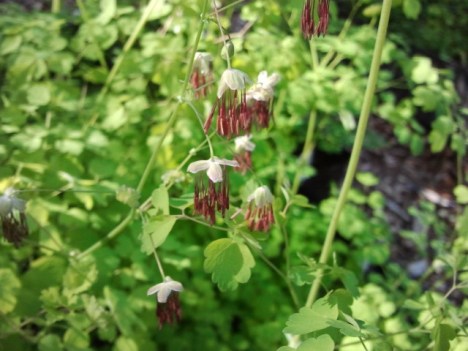
One of those hues, a shade of bluish green, colors the delicate foliage of Western Meadowrue (Thalictrum occidentale). Western Meadowrue is a beautiful tallish (up to 3 feet) perennial that spreads by rhizomes. The male flowers are on separate plants from the female flowers. The small flowers are not showy from a distance but the male flowers are downright glamorous up close.

SAMSUNG

Western Meadowrue (Thalictrum occidentale) male flowers

The female flowers look like pink-and-green fuzz-balls, while the male flowers’ dangling purple anthers that quiver in the slightest spring breeze resemble tiny chandeliers – the kind of fringy chandeliers that you might find in an 1890s brothel . That’s only fitting! It’s all about sex this time of year – plant sex anyhow.

Western Meadowrue grows in bright or partial shade to mostly sun. It is fairly adaptable to moisture conditions and can handle fairly dry (shady) conditions to moist areas such as beside a stream. Western Meadowrue would be quite happy underneath a Vine Maple (Acer circinatum) or Big-leaf Maple (Acer macrophyllum) tree. Fringecup (Tellima grandiflora) would happily keep company with Meadowrue, and I have seen it growing in the wild with Baneberry (Actaea rubra), which is an unusual perennial that gets bright red (unfortunately poisonous) berries. If you want to have truly fulfilled Meadowrue, be sure to procure both genders so they can make babies! Give it some space so that it can spread: by rhizomes or seedlings.

Plant Me, You Fool!

It’s April Fools’ Day, and not too early for spring fever. I have an overwhelming urge to lie down next to the dog in the gravel outside the office and sleep in the sun. But the plants in the nursery are talking too loudly: “Plant me, you fool!” Hanging out in the sun with me, I find three plants particularly relatable: Ocean Spray (Holodiscus discolor), Roemer’s Idaho Fescue (Festuca idahoensis ssp. roemeri) and Oregon Stonecrop (Sedum oreganum).

The Ocean Spray is nicely sprouting its scalloped leaves. A lovely big shrub (9-12 feet tall), Ocean Spray loves full blasting-hot sun in the summer, but can also handle partial shade. Blooming in June, its graceful long clumps of tiny creamy-white flowers make it look like it’s covered in bridal bouquets. They attract tiny pollinators which in turn attracts birds. The flowers fade and hang on through the winter, which many people enjoy as “winter interest” and many insects continue to enjoy as “habitat”.

The other two talking plants make appropriate companion plants for Ocean Spray. These two perennials, Roemer’s Idaho Fescue and Oregon Stonecrop both enjoy the same conditions as Ocean Spray: well-drained soil, sunny and even hot. A clumping grass, Roemer’s Idaho Fescue has gray-green, almost bluish, very fine-textured leaves. Between the clumps of Fescue, low-growing (3-6 inches) Oregon Stonecrop finds space to creep. It is a succulent with plump round leaves that turn from bright green to bronze late in the summer. Its yellow umbrella-like clusters of flowers contrast nicely with the Fescue and provide nectar for bees and butterflies.

Come enjoy a little spring foolishness and see if these plants speak to you! (“Plant me, you fool!”)

VINE MAPLES

I get to ride horseback through the woods with a friend almost every week. We often ride through groves of Vine Maples surrounded by Sword Ferns (Polystichum munitum) and tall Douglas Fir (Pseudotsuga menziesii) overhead. We see the woods change, week by week, throughout the year. In the spring , Vine Maple leaves unfold like fans and the small blooms emerge, intricate, yellow and red. By summer, the trees and undergrowth are thick with leaves and bright light. Even in autumn, the afternoon light – no longer sunny – filters through the Vine Maples’ arching boughs and still-green leaves. Right now, in winter, all the leaves are off the trees and you can see long distances into the forest and admire the shape of the trees. Lush chartreuse and gold mosses on the Vine Maple trunks accentuate the blue-green of their bark.

Vine Maples, beautiful forest understory trees, provide important layers of habitat needed to support bird life. The oldest Vine Maples often lean over nearly horizontal. If a branch gets bent to the ground it can take root and start a new tree, often with multiple stems . When I was a kid I played with my cousins on a jungle gym out in the woods – a grove of sideways-arching Vine Maples. We climbed on them like monkey bars.

Vine Maples do well even if they get a lot of summer sun, although in a blasting hot location (like the exposed south or west side of a building), their leaves will turn color early and burn around the edges. So it’s best to give them some shade; they can handle full shade. And the shade they cast is rejuvenating; sunlight glows green through the thin leaves. A summer rain under those leaves soothes the soul; once I almost bought a house because of the sound the rain was making on the Vine Maple leaves outside the kitchen window.

Seeds in the fall are winged “samaras.” They are a favorite of small mammals. Sometimes I can find a cache of empty seed pods where some little rodent has eaten the nutritious nuts. Vine Maples will really color up well if they have a lot of exposure in an open area. The reds are especially bright during a fall when there has been a long dry spell before the first frost.

Vine Maples are shapely small trees, averaging 20-25 feet tall. They can grow full and wide, with multiple trunks. But for a narrow place or to get the dramatic effect of branches arching overhead, start with a tree that has only one main stem. If you plant two asymmetrically on opposite sides of a wide pathway, their canopies will eventually intertwine. In our yard, Brian planted an Orange Trumpet Honeysuckle (Lonicera ciliosa) in the shade of a multi-trunked Vine Maple. As he intended, the Honeysuckle vine climbed the maple toward the light, up and out to the branch tips, where it bloomed profusely. It is a hummingbird magnet! Also co-existing nicely in the Vine Maple’s bright shade we have Sword Ferns, Largeflower Fairybells (Prosartes smithii), Douglas Iris (Iris douglasiana) and Western Meadowrue (Thalictrum occidentale).

SCARY plants

They say (whoever THEY are) that the chilling descent of rain and darkness upon the Pacific Northwest breeds creatures, nay, organisms, that defy explanation or categorization. We at Tadpole Haven, coupled with our organic practices, impose a strict discipline upon our plants — under which some simply snap. Ugly, sometimes gruesome, some belonging to the brotherhood of the walking dead, these threaten to “go tadpole” on us … Lisa and I, fearing for our welfare, dare not spend the winter surrounded by them.

If you are brave enough, take the opportunity to come to the nursery and peruse these frightening specimens to determine whether you are capable of reforming them.  Over the next few days, we will hunt, stalk, corner, capture, exhume, root out, seize and otherwise incarcerate these gnarliest denizens of our horticultural establishment. We will surround them with ribbons of orange and make them available for adoption for a mere pittance-$1 for plants 1-gallon or smaller, $2 for larger plants. Perhaps you, more saintly members of the community, have the spiritual wherewithal to inspire these plants with wholesomeness once again.

Our Scary Plant Sale runs from Halloween (October 31) through November 5. We will be open on Saturday, October 31 from 10 AM to 4 PM. November 1-November 5 we will be available by appointment only. 

Of course, we will have our usual wonderful selection of perfectly well adjusted native plants which are also seeking good homes. Please see our current retail list.

Sins-eerily,

Shirley Doolittle-Egerdahl, owner

Tadpole Haven Native Plants

WHAT I DID LAST SUMMER

What I did this summer

One morning last June, the dog woofed at a strange lump in our path fifty feet from the lakeshore. It was a turtle.* Its shell was 9-10 inches long, it’s legs were striped yellow, and it had a long red streak along the side of its head–a Red-Eared Slider. I had known this Red-Eared Slider when I was a kid. I’ll get to that later. The dog circled it, barking. I’d heard that they’re invasive, so I knew that in all good conscience, I couldn’t turn it loose again. After a couple of phone calls, I realized no one was going to bail me out. So I picked up the turtle, and with the dog leaping and jumping and barking around me, I carried it up to the nursery where I put some wood chips in a big pot and put the turtle in the pot. But the pot had ridges on it and the turtle was almost climbing out. Just in time, Lisa arrived at work and we moved the turtle into a deep garbage can. When I picked it up, it hissed at me, which was kind of scary.

What to do with it? I did some research, found out they are indeed considered invasive and are a real problem in Lake Washington. Now, let me back up a little bit here–like 49 years–and tell you the story of how this turtle came to live in the lake.

The prequel: When I was a young child I had a series of pet turtles. Almost every kid my age had one. Lisa had one too! These baby turtles (about 2 inches long) came with a kit. It included a clear plastic pool about a foot across that had an island with a ramp and a little plastic palm tree. The first two turtles I had met a bad end. I’m not sure why they died, but it must have had to do with 7-year-old neglect. I do remember my mother nagging me to change the water. The third one that I got I kept in the backyard. I made a fence of bricks and chunks of wood. I buried a dishpan in the ground and put a floating raft in it. But this third turtle disappeared from its idyllic little home. It may have made its way down to Portage Bay (we lived in the Montlake District in Seattle), but I suppose a raccoon could have eaten it. The fourth turtle I named Active, because it was very lively. Active benefited from this little habitat that I had created. But that wasn’t enough for me. One day, our family was on its way out to the lake where we had a summer cabin (where the nursery is now), and I took my turtle along in a bucket. My sister and I took the turtle down to the dock. Wouldn’t it be fun if we let it have a swim in a real lake? So my sister set it in. It swam around nicely–and then made a mad dive for the bottom. My cousin, Neil, dove in and made a valiant attempt to swim down after it. His heroics were in vain. It was quite a scene, yelling and crying.

I never got another turtle. Through the years, there have been very occasional turtle sightings in the lake. I’ve always wondered if the turtle spotted basking on a log was that same turtle, Active. So when the dog and I happened upon the turtle that June morning, I realized that here at my feet, with its head and extremities tucked safely into its shell, sat my former pet. Forty-nine glorious years of freedom had come to an end.**

Active slept in the garbage can overnight and in the morning I did some serious phone calling. The people on the other end of the line–at animal rescues, humane societies, animal controls, PAWS–were not very encouraging. “We’re overrun with Red-Eared Sliders.” “They’re very difficult to place, because they are big, they need water all the time and it has to be changed constantly, so they are a lot of work.” “Some shelters will take them, but they wind up being euthanized.” One or 2 people suggested I could just turn it loose again. Finally, a friend at Just Frogs, Toads Too in Edmonds gave me the number of a no-kill shelter called Forgotten Kingdom. I called him immediately. To my astonishment, he said, “Oh, we are all out of Red-Eared Sliders. Sure, bring it to me and I can find it a home.”

So Lisa and I loaded it*** into an old dog cage and into the back of her car and headed out before the guy could change his mind. He was manning a display at a feed store in Lake Stevens. There was this guy, Paul Lewis,**** sitting outside the store with two cages and some aquariums filled with snakes, lizards, a small tortoise, and of all things, a nutria. He handled my Red-Eared Slider with expertise, declared that it was a female and put it in with the tortoise. He took some time out from our conversation to douse the nutria with water so that the nutria could keep itself clean. This was obviously a man who really cared about animals. Forgotten Kingdom takes species that other shelters won’t. He works hard to find appropriate homes for the animals. As we were talking, the tortoise and the turtle were not getting along. So he moved Active in with the nutria.***** The nutria is a permanent resident in his shelter since nutrias are extremely destructive animals. They destroy whatever habitat they get loose in. Paul brings it to his educational displays so that people can learn what nutrias look like and not mistake a beaver for a nutria— and accidentally shoot a beaver. This nutria is a pet– with a personality. Paul has to bring the nutria along to every display because it gets upset if he leaves it home.

Paul explained that Red-Eared Sliders are tremendously damaging, eating salmon fry and salmon eggs and out-competing native turtles. So when he adopts them out, he makes sure that they have a pool with a fence around it. We left, knowing that Active was in good hands at last and would find a home. As we were driving south again, it struck me what a remarkable person we had just met. A person with such generosity of spirit that he is willing to take in the least wanted animals, that everyone else would give up on. And he is able to encourage others to give them a home. Most of the animals in the shelter are in dire straits because of human carelessness. Nutrias didn’t leave South America and come to North America on purpose-they were brought here. Red-Eared Sliders were exported from their East Coast homes so pet stores could make a lot of money. The invasive turtles and nutrias are just being turtles and nutrias. They can’t help where they wind up.

Some people might call Paul Lewis crazy or naïve to think that he can put a dent in the problem of unwanted animals. I think that he is setting an example for the rest of us. This is the way we should be: generous, hopeful and kind to the least of these.

Hatch a batch of Fairybells

Prosartes smithiiIMGP2294 Prosartes smithiiIMGP2303

The kiddie pools in the nursery have hatched out a new batch of Chorus Frog tadpoles; a batch of salamanders is hatching out in the lake (despite the predations of Tyrannosaurus Gus, my five month old Brittany pup); and of course there is a big batch of weeds to be dealt with. Ah, spring!

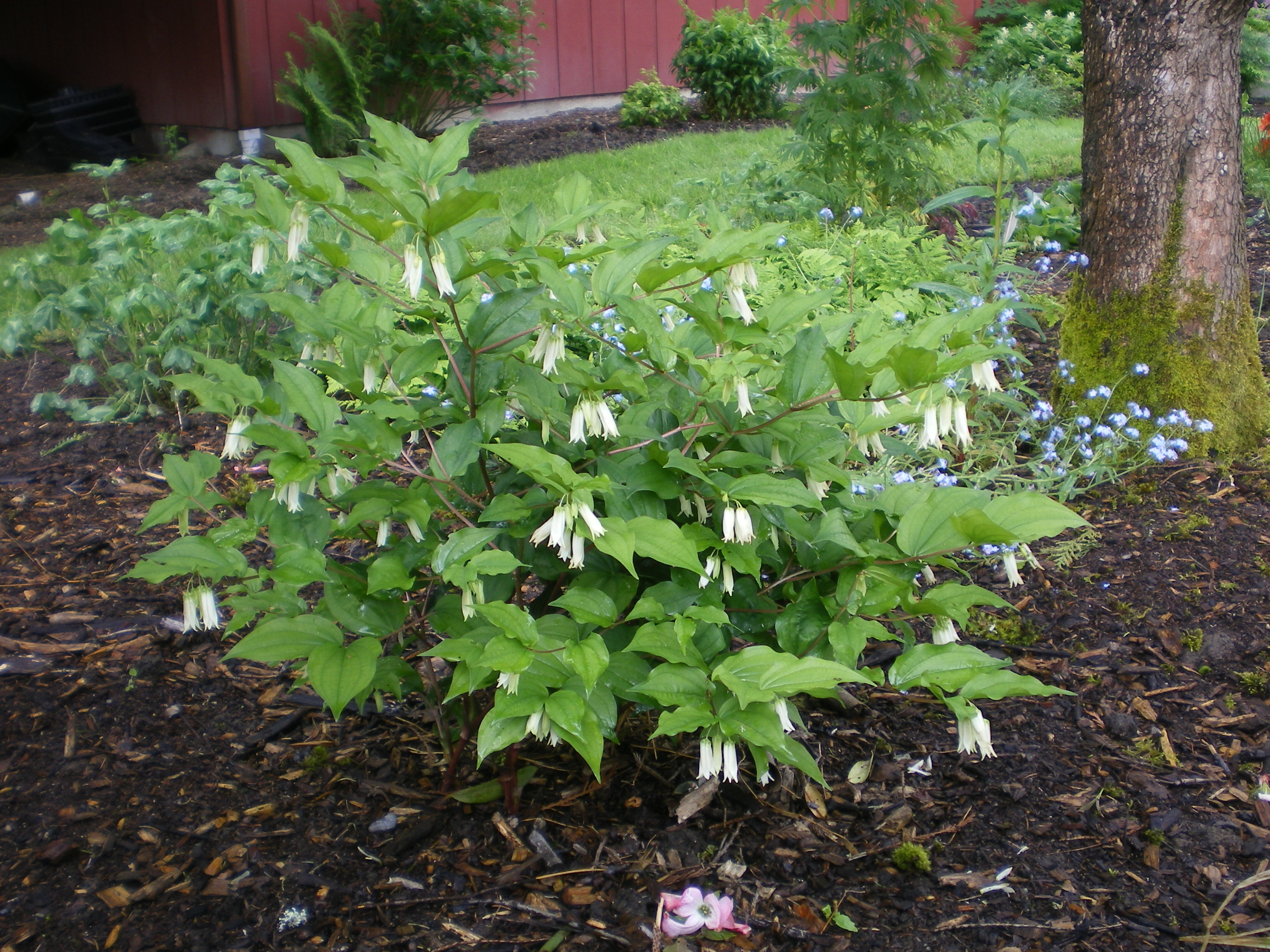
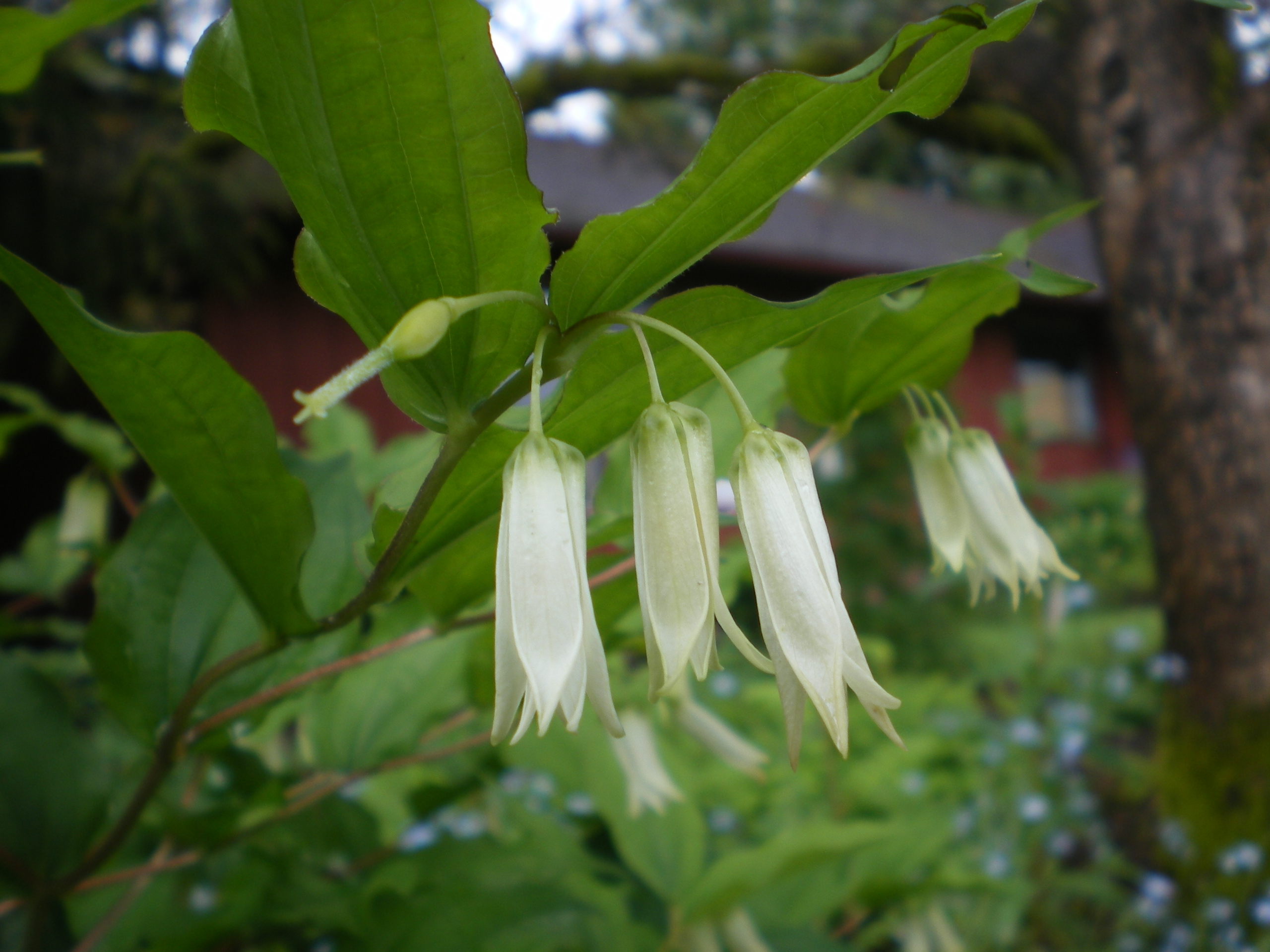
 Tadpole Haven is hatching a big batch of Large-Flower Fairybells (Prosartes smithii).  This perennial grows up to a maximum of three feet tall, has lovely curving stems and creamy yellow flowers. It grows in partial to full shade, in fairly well drained soil, and it makes a good companion for other woodland perennials. In my garden, it grows next to a patch of brilliant green Oak Fern (Gymnocarpium dryopteris). There is absolutely no reason why everyone should not have this plant in their garden!

Large-Flower Fairybells’ flowers give way to oblong berries which are nearly an inch long-quite large in proportion to the diminutive plant. The berries start out yellow, then ripen to orange-red. In the Lily family, Large-Flower Fairybells (a.k.a. Smith’s Fairybells) sprout from the ground in the spring, unfurling their pointed leaves that clasp the graceful branches. Every year the clump grows a little bit larger, and seeds that fall to the ground sprout new seedlings, which can be moved around the garden. Spread the love!

The Quest For Comfortably Naturalized Leprechauns

Have you got your green on? Today I am on a quest for the non-native, though comfortably naturalized, leprechaun of the Northwest. Surprisingly benign, leprechauns outside their native Ireland are not nearly as mischievous as Irish plants that have also snuck in (I could burden you with a list, but I won’t). These harmless leprechauns wander the woods and sneak onto the beaches of Puget Sound, seeking familiar habitats. And indeed, they find familiar plants to tip they’re tiny pointed toes through.  Deep in the shade, they find a lush carpet of our native shamrock-like Redwood Sorrel (Oxalis oregana) and whisper excitedly in their tiny voices, thinking it to be the almost identical native Irish plant Seamsóg. They tuck a few of the lovely pinky-white blooms into their hatbands for good luck. They giggle with delight to find the tasty berries on the Woodland Strawberry (Fragaria vesca) growing at the edge of the forest. It is just the same species as the Irish Sú talún fhiáin!  The leprechauns brave the sunshine (rain-shine? cloud-shine?) to spy out the grass-like clumps and cheery pink blooms of our own native Sea Thrift (Armeria maritima), native in Ireland as well—Rabhán!

Come to Tadpole Haven to tip-toe through the Seamsóg and look at the new sprouts on the Rabhán.  Make yourself at home!  It’s a wee bit early to sample the Sú talún fhiáin, though.